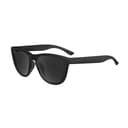
How to choose sunglasses for driving
Driving is a glare problem first and a style problem second. Work through polarization, the screen trade-off, the night-driving rule and field of view, in that order.
Polarization: the daytime glare fix
Light that reflects off a flat, horizontal surface — a wet road, your car hood, the sea — comes back mostly horizontally polarized. A polarized lens is a vertical filter that blocks that horizontal glare while letting the rest of the light through, so the harsh sheen drops away and contrast returns. For daytime driving that’s the single most useful thing a lens can do, which is why the American Academy of Ophthalmology recommends polarized lenses specifically for reflected glare. Our guide to polarized sunglasses explains the mechanism in full.
The LCD-dashboard caveat
There’s one place polarization works against you. Many digital dashboards, in-car nav screens and phone displays emit light that’s already polarized, and when that meets a polarized lens at the wrong angle the screen can look dim, dark or patchy — sometimes disappearing when you tilt your head. It isn’t dangerous, but it’s annoying, and it’s the main reason some drivers deliberately choose a non-polarized lens. If your car leans heavily on a big LCD panel, weigh that trade-off; our polarized vs non-polarized comparison lays out both sides so you can decide which matters more to you.
Never drive at night in a tinted lens
This one isn’t a preference, it’s a safety rule. Any tinted or polarized lens reduces the amount of light reaching your eyes, and at night you need every bit of it. The American Academy of Ophthalmology warns that yellow-tinted “night driving” glasses don’t improve night vision and can actually make it harder to see — so the honest answer for night glare is a clean windshield, a clear pair of prescription glasses with an anti-reflective coating if you wear them, and slowing down. Save every pair on this page for daylight, and skip a very dark lens altogether if most of your driving is at dawn, dusk or after dark.
Field of view, tint and fit
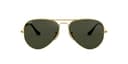
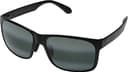
After the lens tech, a driving frame is about seeing wide and staying comfortable for hours. A large lens and thin temples — the classic aviator teardrop is the template — keep your peripheral vision open so you can check mirrors and shoulders without a blind spot from the frame. On tint, a copper, amber or brown lens lifts road-and-sign contrast and is easy on the eyes over a long drive, while a neutral gray keeps colors true; both are fine, but a very dark gray can feel gloomy on an overcast highway. If you’re weighing a premium color-rich lens like the Maui Jim on this list against a glass benchmark like Costa’s, our Costa vs Maui Jim comparison covers that trade-off directly. And because you’ll leave these in the car, pick a pair you won’t mourn if they bake on the dashboard. For more activity-specific lens reasoning, browse our sport sunglasses hub.