Are goodr sunglasses worth it?
For most people, yes — with the caveat that “worth it” depends on what you’re comparing against. Judged as a budget pair, goodr punches well above its price because it nails the two specs that actually protect your eyes and cut glare, rather than just looking dark. Judged against a $200 glass lens, it’s a different product with a different job. Here’s how the pieces stack up.
The lens: real polarization, real UV protection
goodr lists every OG and VRG lens as polarized with UV400 protection. That combination matters. UV400 means the lens filters ultraviolet light out to 400 nanometers — the American Academy of Ophthalmology treats a “100% UV” or UV400 label, not lens darkness or price, as the thing that protects your eyes. Polarization is a separate feature: it kills the horizontal glare bouncing off water, wet roads and car hoods. If you want the full picture on that, our guide to polarized sunglasses and our polarized vs non-polarized comparison walk through when it helps and the one time to take it off.
The grip: why runners adopted them
The reason goodr broke out of the bargain bin is the frame coating. A rubberized, no-slip finish keeps the OG from bouncing or sliding when you sweat, which is the whole game for a running sunglass — a pair that creeps down your nose every quarter mile is worse than none. That’s why the OG lands on our best sunglasses for running shortlist. You don’t get the wrap coverage of a dedicated sport shield, but for road running and everyday wear the hold is genuinely good.
OG vs VRG: which shape
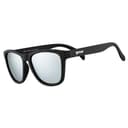
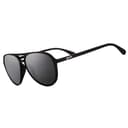
The two share the same lens formula, so the choice is purely about your face and your taste. The OG is a squared retro shape; that angularity adds definition to softer, rounder faces, which is why it’s the more universally flattering pick. The VRG is goodr’s aviator — a metal-look (still plastic) teardrop that suits square and heart-shaped faces and reads a little dressier for driving and everyday wear. Neither is a metal frame, and neither adjusts, so if fit precision matters, check our face-shape guide before you commit.
Who they’re for — and who they’re not
Buy goodr if you want a genuinely polarized, UV400 pair you won’t panic about losing, especially for running. Skip it if you want optical-glass clarity, a real metal frame, or a fit dialed in for a narrow face — at that point you’re shopping a different tier. If you like the cheap-but-honest formula but want to weigh the alternative, see how goodr stacks up against Knockaround in our goodr vs Knockaround comparison.
One more decision the brand makes quietly
goodr states the frame SIZE inside its product titles — “Medium Sized (OG)” against “Large Sized (BFG)” — and almost nobody reads it, which is why most complaints about the OG are really complaints about buying a medium frame for a large head. It sells the same lens in four finishes at one price, too. Our goodr OG review is the model-level page for both of those decisions.