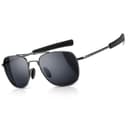
How to choose an aviator
1. Decide about polarization first, because the default is no
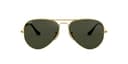
The base Ray-Ban RB3025 — the aviator every other aviator is copying — ships with a non-polarized lens. A polarized version exists and costs meaningfully more. Meanwhile several sub-$30 aviators on this list are polarized as standard.
That inversion is the single most useful fact on this page. If glare control is what you want — and for driving, water and wet roads it usually is — a $17 polarized aviator addresses the problem better than a $180 non-polarized one. The American Academy of Ophthalmology describes polarization as the feature that deals with reflected daytime glare; it does not become more effective at higher prices. Our polarized vs non-polarized comparison covers when you actually need it.
2. Get the lens width right — aviators run large
Aviators are made in a wider size range than almost any other shape, from around 52mm up to 62mm and beyond, and getting this wrong is the commonest aviator mistake. Too large and the lens sits down on your cheeks and the frame extends past your temples; too small and the teardrop looks compressed rather than elegant.
The lens should end around the level of the bottom of your nose, not below it, and the frame should not be wider than the widest part of your face. Our size guide explains the millimeter markings inside the temple and how to measure a pair you already own and like.
3. Use the nose pads — this is the aviator’s hidden advantage
Almost every metal aviator has silicone pads on adjustable wire arms, which an optician can bend in two minutes to raise, lower or tighten the fit. That makes an aviator one of the few frames that can be genuinely tuned to an awkward bridge, and it is why aviators frequently work for people who cannot keep a molded plastic frame on their face.
If your sunglasses rest on your cheeks or slide constantly, our low nose bridge guide covers the whole problem, and our guide to sunglasses sliding down covers the other causes.
4. Think about the tint, not just the darkness
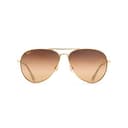
An aviator is most often used for driving, which points toward specific tints. A copper, bronze or amber lens raises apparent contrast, so road texture and brake lights separate more clearly — that is why the premium pick here uses a bronze lens rather than a neutral gray. A neutral gray keeps color accurate and is more comfortable for sustained bright sun.
Green G-15, the classic Ray-Ban tint, sits between the two: close to neutral with a slight green cast. Our lens colors guide has the full tint-by-condition table.
5. Bayonet vs curved temples
A detail worth knowing because it changes how the frame behaves. Original military aviators use bayonet temples — straight arms with no hook, designed to slide under a flight helmet. Straight temples are more comfortable under a hat, a helmet or a headset, and they grip less, so they can creep forward when you look down. Curved temples hook behind the ear and stay put.
If you wear a helmet or a hat a lot, look for bayonet. If your glasses already slide, avoid them.
Who aviators suit — and who they do not
The shape works best on faces that need softening or balancing at the bottom. A square face gets its strong jaw softened by the curve; a heart-shaped face gets its taper echoed rather than fought; an oval face gets a frame that follows its natural line so closely it reads as effortless.
Where it is harder: a round face, where the curved lens adds more curve to features that already have plenty — an angular frame is the corrective choice there. And a genuinely small face, where even the smaller aviator sizes can overwhelm. Our face-shape guide has the full method.
Where to spend and where not to
This is a category with an unusually honest budget option, because an aviator is a simple object: wire, hinges, pads, two lenses. There is less for a cheap manufacturer to get wrong than in a sport wrap with complex geometry, which is why a $17 polarized aviator is a genuinely reasonable purchase rather than a compromise.
The premium tier buys three things. A tuned lens tint that raises contrast rather than just dimming — the strongest argument, and what the Maui Jim pick is about; our Maui Jim review covers it. Frame metal that holds its shape for a decade. And a silhouette with genuine heritage rather than a copy of one, which our Ray-Ban review and Wayfarer vs Aviator comparison get into.
What the premium does not buy is UV protection, which every pick here provides. For more of the everyday range, our everyday hub covers men’s, women’s, budget and gift picks, and our under-$100 roundup covers the middle of the market across all shapes.
The RB3025 is sold in both a standard and a polarized trim at different prices, and Ray-Ban polarized versus non-polarized compares the same frame with that one variable changed.