Shade & Temple

Julbo Sunglasses Review

Julbo is a mountain company that happens to make sunglasses, and it shows in the one thing it does better than anyone: lenses that go genuinely dark. Here is who needs that, and who is buying far more lens than they will ever use.

By Stephen V.Last updated How we pick

Most sunglasses brands start from style and add performance. Julbo started in the French Jura making protective eyewear for crystal hunters working in the mountains, and has spent a century since then on the same problem: what do you put in front of your eyes at altitude, on snow, where the light is genuinely dangerous rather than merely uncomfortable.

That heritage produces a range with an unusual center of gravity. Where most brands top out at category 3 — ordinary bright sunlight — Julbo’s signature lenses reach category 4, transmitting under 8% of visible light, and its REACTIV photochromic family spans several categories in a single lens. It also produces a range that is genuinely wrong for a lot of buyers, which is the more useful thing to say in a review.

The honest framing: if you go above the treeline, spend days on snow, or ski tour, Julbo is doing something almost nobody else does and it is worth the money. If you want a good pair of sunglasses for driving and walking around town, you are looking at the wrong brand, and a category 4 lens is not legal for driving in many places. Below, the two models we cover and who each is for.

How this is funded: we earn a commission if you buy through our links, at no extra cost to you. It never changes which product we recommend, and we’ll tell you when we’d skip one. Full disclosure.

The case for

  • REACTIV photochromic lenses span multiple filter categories in one lens, including a 2-to-4 range
  • Genuine category 4 mountain tints, which very few brands sell at all
  • Polarized options within the photochromic range, which is rare and useful on snow
  • Frames designed around real mountain problems — removable side shields, coverage from below

The trade-offs

  • The Amazon listings publish no UV figure, no lens material and no weight — for the price, that is a real gap
  • Category 4 lenses are not approved for driving in many jurisdictions
  • The flagship photochromic is the most expensive pair on this site by some margin
  • Overkill, and uncomfortably dark, for anyone who is not regularly at altitude

Best for: ski touring, glacier travel, high-altitude hiking and anyone whose eyes hurt in conditions where a category 3 lens is not enough.

Skip it if: you want an everyday pair — a category 4 lens is too dark for driving and not legal for it in many places, and you are paying for range you will never reach.

Quick picks

Ranked on lens spec, UV protection, tint fit and buyer value. Select a row to jump to the full write-up. We have not field-tested these — here is exactly what we do instead.

#ProductBest forPrice
1
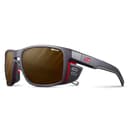
Julbo Shield (REACTIV 2-4 Polarized)

Julbo Shield (REACTIV 2-4 Polarized)

The reference glacier frame, and the one pick here that solves high-altitude snow properly. The REACTIV lens is photochromic across categories 2 to 4, meaning it self-adjusts from ordinary bright daylight all the way to the category 4 darkness you want on a glacier, and it is polarized on top of that. Removable side shields block the light coming up off the snow at your cheekbones.

Best overall for the mountains
$249.95 · View on Amazon

Price as of September 4, 2026. #ad How we’re funded

2
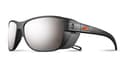
Julbo Camino (Spectron 4)

Julbo Camino (Spectron 4)

The affordable route into a genuine category 4 mountain lens. Spectron 4 is a fixed, very dark tint with a silver mirror — no photochromic cleverness, no polarization, just the light transmission you actually need above the treeline on snow. At roughly a quarter of the Shield's price it is the sensible choice if you go to altitude a few times a year rather than every weekend.

Best value route to category 4
$69.95 · View on Amazon

Price as of September 4, 2026. #ad How we’re funded

The models, in full

#1Best overall for the mountains

Julbo Shield (REACTIV 2-4 Polarized)

The reference glacier frame, and the one pick here that solves high-altitude snow properly. The REACTIV lens is photochromic across categories 2 to 4, meaning it self-adjusts from ordinary bright daylight all the way to the category 4 darkness you want on a glacier, and it is polarized on top of that. Removable side shields block the light coming up off the snow at your cheekbones.

Strengths

  • REACTIV photochromic across categories 2 to 4 — one lens from bright daylight to glacier glare
  • Polarized as well as photochromic, which is rare and genuinely useful on snow
  • Removable side shields cut the reflected light coming up from below

Trade-offs

  • Category 4 lenses are not legal for driving in many places — this is a mountain tool, not a road pair
  • The most expensive pair on this site by some distance
Lens featureREACTIV photochromic category 2-4, polarized, side shields
PolarizedYes
Lens tintBrown, REACTIV photochromic (category 2-4)
Frame materialNot published
UV protectionNot published
Best forSkiing, Mountaineering, Glacier travel, Altitude

Spec note. The listing states a brown REACTIV 2-4 polarized lens — a photochromic lens that darkens across filter categories 2 to 4. Category 4 lenses transmit under 8% of visible light and are not approved for driving.

Specs read from the product listing, on August 11, 2026. “Not published” means the brand does not state that figure.

#2Best value route to category 4

Julbo Camino (Spectron 4)

The affordable route into a genuine category 4 mountain lens. Spectron 4 is a fixed, very dark tint with a silver mirror — no photochromic cleverness, no polarization, just the light transmission you actually need above the treeline on snow. At roughly a quarter of the Shield's price it is the sensible choice if you go to altitude a few times a year rather than every weekend.

Strengths

  • A true category 4 mountain tint at a mid-range price
  • Silver mirror coating reflects more light before it reaches the lens
  • Wrapped frame shape blocks light arriving from the side and below

Trade-offs

  • Category 4 is too dark for driving and is not legal for it in many places
  • Fixed tint — no photochromic range, so it is uncomfortably dark in the trees
Lens featureSpectron 4 category 4 mountain tint, mirrored
PolarizedNot published
Lens tintBrown with silver mirror (Spectron 4)
Frame materialNot published
UV protectionNot published
Best forSkiing, Hiking at altitude, Snow, Glacier travel

Spec note. The listing states a Spectron 4 lens — Julbo's category 4 mountain tint — in brown with a silver mirror. Polarization is not stated for this trim.

Specs read from the product listing, on August 11, 2026. “Not published” means the brand does not state that figure.

REACTIV and Spectron, decoded

Julbo uses two lens family names and they mean genuinely different things, which is worth getting straight before you shop.

Spectron is a fixed tint. Spectron 4 is Julbo’s category 4 mountain lens — very dark, usually mirrored, and unchanging. No cleverness, just the light transmission you need above the treeline on snow. It is the cheaper route into the brand’s core competence.

REACTIV is the photochromic family, which Julbo introduced in 2011 and builds on what it calls the SHR, or Super High Reactiv, process. REACTIV lenses are sold in several category spans rather than one, with Glare Control and High Polarization options depending on the variant. The variant that matters most is the one that runs from category 2 to category 4 with polarization — a single lens that covers ordinary bright daylight through to glacier glare.

That is the genuinely distinctive product. Photochromic lenses are common; photochromic lenses that reach category 4, and that are also polarized, essentially are not. Our photochromic vs polarized comparison covers why combining the two is unusual and what it costs you.

What category 4 actually means, and why it is a commitment

The filter category scale runs from 0 to 4 and describes visible light transmission. Category 3 — roughly 8–18% transmission — is where almost all good sunglasses sit and covers ordinary bright sun. Category 4 transmits under 8%, and exists for environments where category 3 is genuinely insufficient: glaciers, high-altitude snow, sustained time above the treeline.

Two consequences follow, and Julbo buyers need both.

  • Category 4 lenses are not approved for driving in many jurisdictions, and are unsafe for it regardless of local law. This is not a footnote — it means a Spectron 4 or a fully-darkened REACTIV lens is mountain equipment you take off before you drive home.
  • They are uncomfortable when you do not need them. A category 4 lens in ordinary conditions is not a better sunglass, it is a lens that makes a normal day look like dusk.

Our lens categories guide sets out the whole scale and which band belongs where.

Why altitude changes the requirement

The reason a whole product category exists for mountains is that ultraviolet exposure genuinely rises with elevation — the FAA puts the increase at roughly 5% per 1,000 feet, which is the same atmospheric physics whether you are in a cockpit or on a col.

Snow then compounds it. A snowfield reflects a large fraction of incident light back upward, so you receive the direct dose and a substantial reflected dose from below. The AAO’s guidance on photokeratitis — the painful corneal sunburn commonly called snow blindness — is a direct consequence of exactly this. Our skiing and snow roundup covers the problem in full.

That reflected-from-below component is also why Julbo’s frames have removable side shields rather than merely dark lenses. The lens handles what arrives from in front; the shields handle what comes up at your cheekbones. A very dark lens with open sides is solving half the problem, which is the mistake most people make when they buy for a mountain trip. Our base curve and wrap guide covers coverage geometry.

The disclosure gap, stated plainly

Our criticism of Julbo is specific and it is about what the retail listings publish rather than about the product. Neither of the two models we cover states a UV figure, a lens material or a weight on its Amazon listing. Our product cards record all three as not published, because we do not fill gaps.

For a brand at this price, that is a genuine shortcoming. A category 4 tint is not itself a UV claim — darkness and ultraviolet filtering are unrelated properties, and the AAO is explicit that a dark lens without UV protection is worse than none. Julbo’s own technical material describes its lenses as filtering ultraviolet, and it would be surprising if a mountaineering specialist did not, but a reasonable buyer should be able to read that off the listing rather than infer it.

The practical answer is the same as everywhere else: ask, or have an optician read the lens. Our UV testing guide explains the check.

Which model, and who for

The Shield — if you are actually going

A REACTIV 2-to-4 polarized lens with removable side shields. This is the brand’s argument in one product: a single lens that behaves like ordinary sunglasses at the trailhead and like glacier goggles at the top, plus polarization for the glare coming off snow, plus shields for the light arriving from underneath.

It is the most expensive pair on this site, and for genuine ski touring or glacier travel it is the right purchase. Note the structural limitation of any polarized photochromic: it never goes fully clear, because the polarizing filter is always present.

The Camino — if you go a few times a year

A fixed Spectron 4 lens with a silver mirror in a wrapped frame, at roughly a quarter of the Shield’s price. No photochromic range and polarization is not stated for the trim, but it delivers the thing that actually matters at altitude: category 4 transmission with a mirror coating reflecting light away before it reaches the lens.

For most people who go to the mountains occasionally rather than weekly, this is the sensible buy. The trade is that a fixed category 4 lens is uncomfortably dark in the trees, so it lives in the pack until you are above them. Our mirrored sunglasses guide covers what the mirror contributes.

How Julbo compares

Against Oakley, the comparison is about specialization. Oakley’s Prizm tints are engineered for specific environments and its lens standard is stated plainly — Plutonite filters 100% of UVA, UVB and UVC to 400nm regardless of tint. What Oakley does not really do is category 4. If your problem is a golf course or a road, buy Oakley; if it is a glacier, Oakley does not have the answer. Our Oakley review covers the range.

Against Tifosi, the comparison is price for photochromic. Tifosi’s Fototec lenses cover the everyday photochromic case at a fraction of REACTIV’s cost, including a polarized option, but they do not reach category 4. Our Tifosi vs Oakley comparison covers that end of the market.

Against the budget category 4 options, of which a few exist, the difference is frame engineering and lens consistency rather than headline darkness. If you are going somewhere serious once, a cheap category 4 lens with side coverage beats no protection considerably. Our brands roundup sets out the field.

Our verdict

Julbo is one of the few brands on this site making a product with no real substitute. If you spend time above the treeline, the REACTIV 2-to-4 polarized lens is the most capable single lens available and the side-shield frames are designed around the right problem.

But most people buying sunglasses are not going above the treeline, and for them this is the wrong brand at the wrong price with a lens that is illegal to drive in. Buy Julbo for the mountains and something else for everything else — and whichever model you choose, ask about the UV figure the listing does not print.
Frequently asked questions

What is the difference between Julbo REACTIV and Spectron lenses?

Spectron is a fixed tint — Spectron 4 is the category 4 mountain lens, very dark and usually mirrored, with no photochromic behavior. REACTIV is the photochromic family Julbo introduced in 2011, built on its SHR (Super High Reactiv) process and sold in several category spans, with Glare Control and High Polarization options depending on the variant. The standout is the polarized 2-to-4 REACTIV, which covers ordinary daylight through to glacier glare in one lens.

Can you drive in Julbo category 4 sunglasses?

No. Category 4 lenses transmit under 8% of visible light and are not approved for driving in many jurisdictions, and they are unsafe for it regardless of local law. That applies to Spectron 4 and to a REACTIV lens in its fully darkened state. Treat a category 4 lens as mountain equipment you take off before driving home, and keep a category 3 pair for the road.

Do Julbo sunglasses block UV?

Julbo's own technical material describes its lenses as filtering ultraviolet, and it would be surprising if a mountaineering specialist did not — but neither of the Amazon listings we cover states a UV figure, so our product cards record it as not published rather than assuming. This is our main criticism of the brand at retail. Darkness is not a UV claim: the AAO is explicit that a dark lens without UV filtering is worse than no sunglasses at all.

Are Julbo sunglasses worth the price?

For their intended use, yes — a polarized photochromic spanning categories 2 to 4 has essentially no substitute, and the side-shield frames address the reflected light coming up off snow that a dark lens alone does nothing about. For general use, no. You would be paying a large premium for range you will never reach, in a lens too dark to drive in. Buy Julbo for the mountains and something else for everything else.

Why do Julbo frames have removable side shields?

Because at altitude on snow, a large part of the light reaching your eyes arrives from below, reflected off the snowfield, rather than from in front. A very dark lens with open sides solves only half the problem — which is the classic mistake people make buying for a mountain trip. The shields close the gap at your cheekbones. They come off because that coverage is unnecessary and warm below the treeline.

Julbo or Oakley for mountain use?

Julbo, and it is not close if you mean genuine altitude. Oakley's strength is environment-specific Prizm tints and a plainly stated lens standard — Plutonite filters 100% of UVA, UVB and UVC to 400nm regardless of tint — which makes it excellent for golf, road cycling and fishing. What Oakley does not really do is category 4. For glacier travel and ski touring, Julbo is solving a problem Oakley's range does not address.

Sources

Keep reading