How to choose glacier glasses
Four criteria, in the order that actually protects your eyes rather than the order the category advertises.
1. A stated UV rating, which is not the category number
Filter category describes light transmission. Category 0 passes 80–100% of visible light, category 3 passes 8–18%, and category 4 passes under 8%. UV blocking is measured separately — the FDA’s own device page for sunglasses points at the ANSI Z80.3 and ISO 8980-3 standards for both UV and light transmittance, as two different things. A lens can be category 4 and have no meaningful UV filter, and a clear lens can block 100% of UV. The AAO makes the consumer version of the point bluntly: look for 100% UV or UV400, and a darker lens is not a more protective one.
This matters more on snow than anywhere else, because the injury you are avoiding is a UV injury. Photokeratitis — the corneal sunburn known as snow blindness — is caused by ultraviolet, not by brightness, and the AAO’s prevention advice is eyewear that blocks 99% or more of it. A very dark lens with a weak UV filter is worse than useless: it opens your pupil and then lets UV through the larger aperture. That is the single most important sentence on this page.
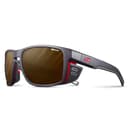
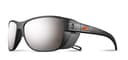
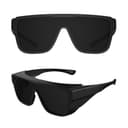
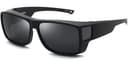
Of the four picks below, the CAXMAN fit-over states UV400 on its listing. The two Julbos and the Goiteia state filter category and lens technology but no UV figure for the specific SKU we link, so their cards say “Not published.” We have not inferred one. Julbo is a long-established mountain optics brand and it would be unsurprising if its lenses blocked all UV; but “unsurprising” is not a specification, and this site does not fill that gap with a guess. If you want the brand’s own words on the lens family, our Julbo review is where we set out what the company publishes and what it does not.
2. Side coverage, because the light is coming from below
Snow is close to the most reflective natural surface you will stand on, and the AAO’s winter eye-safety guidance is built around exactly that: UV bounces off snow and ice, and the risk rises with elevation. Combine the two and the geometry is unusual — you are being lit from above by direct sun and from below by reflection, with very little of the atmosphere left to absorb either.
A frame deals with the light from below in three ways, in increasing order of effectiveness: a lens with wrap, a frame that sits close to the cheekbone, and an actual side shield. Only the third closes the gap. This is also why the AAO names wraparound and oversized frames together for maximum coverage — coverage is a frame property, and it is the one thing no lens upgrade can buy you. If you are not going onto snow, you probably do not need shields, and our wraparound roundup is the right page instead.
Removable shields are worth paying for. The reason is not styling — it is that shields trap warm air in front of the lens, which means they fog on a climb and clear on a descent. Being able to take them off when you drop below the snowline is the difference between a frame you wear all day and one you push onto your forehead. The anti-fog roundup explains why a sealed frame and a fog-free frame are opposite requirements.
3. Darkness, and knowing when it is too much
Category 4 exists for a genuinely extreme case: sustained travel on snow or ice in high-altitude sun, where a category 3 lens leaves you squinting all day. Outside that case it is the wrong lens, and the reasons are practical rather than theoretical. A category 4 lens is not approved for driving in many jurisdictions and is a bad idea everywhere — you will be wearing it when you get back in the car, and it is too dark to be safe there. It is uncomfortably dark in trees, in cloud, and on the walk-in before the sun clears a ridge. And it does nothing extra for your eyes: the protection comes from the UV filter, not the tint.
Two ways out of the trade. A photochromic lens that spans categories 2 to 4 — which is what Julbo’s REACTIV family does, and the brand describes it as a lens range offered in several category spans with glare-control and high-polarization options — gives you one pair for the walk-in and the glacier. Or you accept a fixed category 4 and carry a second, ordinary pair for everything else, which is cheaper and is what most people actually do. Our page on photochromic lenses covers how the technology works and its limits, including the one that matters in a car.
4. Whether you wear glasses, which the category mostly ignores
“Glacier glasses prescription” is one of the most-searched variants of this term and the honest answer has three branches. Prescription category 4 lenses in a mountain frame are the best solution and the most expensive one — the AAO notes that sunglasses can be made in nearly any prescription, but a steeply wrapped frame is harder and dearer to fill than a flat one, which is set out in our prescription sunglasses guide. Contact lenses plus any of the frames above is the second branch and the one most mountaineers choose. The third is a fit-over, which is what the CAXMAN pick is: a category 4 dark lens with side shields that goes on over your own frames for about twenty dollars.
It is not a technical frame and it does not pretend to be, but it is the only product we found that combines a category 4 lens, side shields and fit-over geometry — and for someone going up once rather than every weekend, it is the difference between going and not going. Our page on sunglasses that fit over glasses covers how to measure your own frames so a fit-over actually fits, which is the step people skip.
One thing none of these fixes: close focus. If the thing you cannot see on the hill is a map, a GPS screen or a knot in a cord, that is presbyopia rather than a distance correction, and the product for it is a bifocal sunglass — a magnifier in the bottom of a tinted lens. None of them comes in category 4, so on a glacier the realistic answer is to carry a cheap pair of readers in a chest pocket and keep the dark lens for looking up.
Glacier glasses vs ski goggles vs ordinary sunglasses
Three products, three jobs, and the choice is decided by wind and precipitation rather than by altitude. A goggle seals to your face, which is what you want when you are moving fast downhill in wind or falling snow, and it is also why it fogs on an uphill. Glacier glasses ventilate, which is what you want moving slowly uphill with a pack on. Ordinary sunglasses do neither job on snow, because they leave the gap at your cheekbone open.
In practice a ski tourer carries both and swaps at the top. A mountaineer on a glacier approach wears glasses and keeps a goggle in the pack for weather. A resort skier needs a goggle and, usually, a category 3 sunglass rather than a category 4 — which is why our skiing and snow roundup ranks different frames from this page, and why sunglasses vs goggles exists as its own decision. For trail hiking below the snowline, good wraparound sunglasses are genuinely adequate and our hiking roundup is the page you want.
What we checked and did not feature
This is a small category once you apply a stated-UV requirement to it, and it is worth recording what fell out.
Leather side-shield aviators.The classic look — a metal aviator with stitched leather shields — is still sold, still in stock, and priced in the same band as the Goiteia. The listing we checked states polarization and names mountaineering and glacier use in its title, but publishes no UV rating and no filter category. Two missing specs on a page about those two specs is disqualifying, so it is not featured.
Super-dark frames with removable shields but no category. Several frames are sold as “super dark” with detachable side panels and polarization, at the same price as the picks above, and none we checked states a filter category. “Super dark” is marketing copy; category 4 is a number with a test behind it.
A second Goiteia SKU.The brand sells a silver-mirror CAT4 alongside the extra-dark version we picked, and its detail page carries a genuinely useful 5% light-transmission figure — but the description served for that listing is headed as the super-dark variant while the catalog returns the SKU as the mirror one. On a page arguing that the category number is a measured value, a listing that serves another variant’s numbers cannot be used.
Clip-on side shields sold on their own. They exist, they cost almost nothing, and they are safety-glasses accessories rather than eyewear. They do not turn a category 3 sunglass into a glacier glass, because the lens is still passing two to three times the light. If you want to improve a pair you already own for a snow day, a brimmed hat does more than any accessory, and it is free.