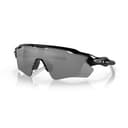
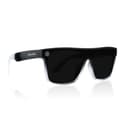
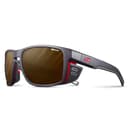
What a shield actually gives you
Three gains, and they are specific rather than stylistic.
No bridge in your sightline.On a two-lens frame there is frame material between your eyes. You stop noticing it, but it is there, and on anything where you are tracking a moving object across your field — a ball, a wheel in front of you, a trail — a continuous lens is a genuinely cleaner view.
Coverage above and beside the eye.The AAO’s advice on frame choice is about geometry, not tint: it recommends wraparound or oversized frames so that light cannot arrive around the lens. A tall shield closes the gap at your eyebrow, which is the one most frames leave open and the one that matters when the sun is high. Our walking roundupdeals with the opposite case — low sun, where the gap that matters is at the side.
One piece, fewer failure points. There is no second lens to come loose and no central hinge in the lens plane. On frames in this shape the thing that usually breaks is a temple, not the lens mounting.
What one lens costs you
1. Optics at the edges of the lens
A shield has to curve hard to wrap your face, and curvature is where sunglasses optics get difficult. The optical trade press describes high-wrap frames as typically needing 8-base lenses, and is explicit about the consequence in prescription form: the prescription “isn’t as true and can result in blurriness as the patients’ eyes rotate to use the periphery.” In a non-prescription lens the effect is milder, but it is the same effect — look hard to one side through a steeply wrapped lens and the world moves slightly.
This is the single best argument for buying a shield from a brand that makes lenses rather than frames. It is also why shield-shaped fashion frames at ten dollars are a different product from the ones on this page: the shape is the easy part.
2. No lens swapping
Interchangeable-lens sport frames give you a clear lens for dusk and a dark one for midday for the price of one frame. On most shields you get the lens the frame came with. If your light genuinely changes, the honest answer is either a photochromic lens — see our photochromic roundup— or a different frame entirely.
3. Fit is less forgiving, and it is worse on a small face
“Best shield sunglasses for small faces” is one of the ten things Google suggests for this shape, which tells you it is a real problem. A one-piece lens cannot be made narrower without making it shorter, so a shield sized for a wide face sits on the cheekbones of a narrow one and touches the eyelashes. If your frames normally slide or sit too wide, start at our small-faces roundup rather than here; if the problem is the reverse, the NEVEN pick above is sold in an L/XL fit and our big-heads roundup covers the rest.
4. It is a committed look
Worth saying plainly, because it is the reason most people who like the idea do not buy one. A shield reads as sport or as fashion-forward and rarely as neutral. If you want the coverage and not the statement, a wraparound gets you most of the way there and our wraparound roundup ranks six of them.
Why there are only three picks
Because we required the listing to actually state a one-piece lens, and in a registry of ninety-five products that leaves three. The shape is everywhere in fashion eyewear right now and almost none of it publishes a lens specification: plenty of frames are sold as “shield style” with no UV rating, no lens material and no filter category. We would rather run a three-item list than inflate it.
Sport wraparounds sold as shields. Several excellent sport frames in our registry have a curved two-lens front and get marketed with shield language. They are ranked on best wraparound sunglasses and on the activity roundups, because calling them shields here would make the word mean nothing.
Fashion shields with no lens spec. The one-piece visor-style frames sold in the ten-to-twenty-dollar band are the single largest group in this shape and the easiest to reject: no stated UV rating on a very dark lens is the exact combination the AAO warns about, since a dark lens opens your pupil and an absent UV filter then lets ultraviolet through the wider aperture. Our guide to spotting fakes covers how that market works.
Side-shield mountain frames.Worth separating from this page because the words collide. “Side shields” are panels that close the gap at your cheekbone on snow, and they are protective hardware rather than a frame shape — a two-lens frame can have them and a shield can lack them. They are covered on best glacier glasses, where the reason for them is reflected ultraviolet coming up off snow.
Can you get a shield in a prescription?
Sometimes, and it is the hardest prescription in sunglasses. The AAO notes that sunglasses can be made in nearly any prescription, but a steeply wrapped one-piece lens is where the trade press’s warning about peripheral accuracy bites hardest, and compensated free-form designs exist precisely because of it. Expect a dispenser to take position-of-wear measurements and expect it to cost more than a flat frame. The cheaper routes — contact lenses under any frame on this page, or a separate pair — are covered in our prescription sunglasses guide.
The same lens with the frame taken away
Worth knowing before you commit to a shield: the one-piece lens also exists without a frame around it. A one-piece rimlesshas the arms screwed straight to the edges of the lens, so there is no frame line anywhere in your view — not at the bridge, and not at the top either. You gain the last bit of unobstructed vision a shield still blocks, and you give up the frame that protects the lens edge, the ability to glaze it, and some of the coverage. Our best rimless sunglasses roundup ranks that build against the drilled and semi-rimless alternatives and explains which of the three suits which buyer.