How to choose sunglasses for a long face
1. Lens height is the specification that matters
Almost nobody shops on lens height, which is why so many long-faced buyers end up with a frame that fits and still looks wrong. The three numbers printed inside a temple arm are lens width, bridge width and temple length — height is not among them, and it is the one you need.
The practical approach: measure the lens height of a frame you already own and like, in millimeters, top edge to bottom edge at the deepest point. Then look for listings quoting a greater figure, or use the product photograph — a deep lens is visible at a glance. As a rough guide, anything under about 40 mm will read as shallow on a long face, and 45 mm and up starts doing real work. Our size guide covers measuring properly.
2. Look for a low or decorated bridge
A subtle trick that makes a real difference. A frame whose bridge sits low, or which has a visible double bridge or a strong browline, introduces a horizontal element partway down your face. That interrupts the unbroken vertical sweep from hairline to chin, and the eye reads the face as shorter.
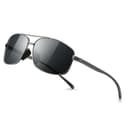
A high, thin, invisible bridge does the opposite — it lets the eye travel straight down. This is one reason the classic aviator, for all its virtues, is not the strongest choice here: its bridge sits high and its teardrop lens narrows towards the bottom.
3. Use the temples, not just the front
Decorated, contrasting or wide temple arms add horizontal emphasis at the sides of your face, which counteracts length in the same way a low bridge does. Thin wire temples disappear and contribute nothing.
This is a place where a chunkier acetate-style frame genuinely outperforms a delicate metal one on proportion alone. Our frame materials guide covers how the two behave differently in wear, and the wayfarer roundup covers the archetypal thick acetate frame.
4. Go slightly wider than your face, not narrower
The one place the conventional advice still applies, with a modification. A frame that is narrower than your face pulls the eye inward and makes the face read as longer and thinner. A frame that is level with or very slightly wider than your cheekbones adds the horizontal balance the shape wants.
The caution is that width without height is the trap described above. Wide and deep is the target; wide and shallow is worse than neither. If you also have a genuinely large head rather than just a long face, our big heads and wide faces roundup covers frames sized for it, and one pick on this list appears on both pages for that reason.
5. Coverage improves along with the proportion
A pleasant coincidence: the frame that flatters a long face is also the frame that protects it better. A tall lens closes the gap between the bottom of the frame and your cheekbone, which is where reflected ultraviolet arrives from — off pavement, water, sand or snow.
The AAO recommends wraparound styles for exactly this reason. So on this face shape, unusually, the aesthetic advice and the eye-health advice point the same way. Our base curve and wrap guide explains the geometry, and our UV protection guide covers why coverage matters as much as the lens.
6. Do not over-correct into an oversized frame
The commonest overshoot. Having read that depth helps, people buy the deepest frame they can find and end up with a lens that reaches their cheekbone and touches it when they smile. A lens resting on your cheek fogs, slides and marks the skin.
The test is simple: put the frame on and smile. If the lower rim touches your cheek, the frame is too deep, regardless of what the proportion rule says. Our slide-down guide covers what happens next when it does.
Shapes that work, and shapes that do not
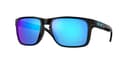
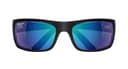
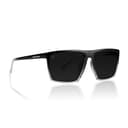
- Deep rectangles and squares: the strongest match. Even widths across your face mean a squared frame does not fight any part of it, and the height does the balancing. Our rectangular roundup is the shape page.
- Large round frames: genuinely good, and often overlooked. A big circle is as tall as it is wide by definition, which is precisely the proportion a long face lacks. Our round roundup covers them.
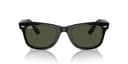
- Wayfarers and squared acetate frames: the depth is there and the thick temples help. A reliable default.
- Shallow rectangular “visor” frames: the shape to avoid. A wide, short lens is a horizontal band across a vertical face and exaggerates both.
- Small round or narrow oval frames: too little of everything. They leave the vertical sweep uninterrupted and read as undersized.
- Classic aviators:workable but not optimal — high bridge, and the teardrop narrows towards the bottom. A larger lens width helps. See our aviator roundup.
Long face or narrow face?
Worth separating, because the advice diverges. A long face is about the ratio of length to width and can be any absolute size. A narrow or small face is about absolute measurements — the distance between your temples is simply less than standard frames assume.
If standard frames sit out past your temples or slide constantly, that is a sizing problem rather than a proportion one, and our small faces roundup is the right page. Some people are both, in which case look for a deep lens on a narrow frame front — a genuinely difficult combination to find, and worth using the size numbers rather than photographs to hunt down.
Where to spend and where not to
Spend on lens height and on coverage, because on this face shape they are the same purchase and both are functional rather than cosmetic. Spend on polarization if you drive or spend time near water.
Do not spend on an oversized designer frame in the belief that bigger is automatically better here — past the point where the lens meets your cheekbone, more depth is actively worse. And do not accept a frame with no published UV figure because the proportions are right; our UV testing guide covers what you can and cannot verify. The fit hub has the guides for the other face shapes.