How to choose, in the right order
1. The lens, before anything else
Check the listing for UV400 or 100% UVA/UVB. If it is not stated, assume it is not there — a reputable maker advertises it, because it is the one claim that sells a lens. Prevent Blindness puts it simply: buy only sunglasses that carry a clear statement of UV blocking, and look for 99–100% of both UVA and UVB.
This is not a premium feature. The $14 SOJOS pair on this list states UV400 and polarization; plenty of $90 fashion frames state neither. Price is not the signal. Our UV protection guide covers what the label means and what it legally does not.
2. Polarization, if you spend time outdoors
A polarizing filter removes the horizontally oriented light reflecting off flat surfaces — the sheet of white on a lake at noon, the shine off a wet road, the glare from a car hood in front of you. It is the single most noticeable upgrade a lens can offer for daily life, and it is the reason a good $30 pair can outperform an expensive non-polarized one at the beach.
Worth knowing: polarization can make some phone screens and car dashboard displays go dark at certain angles, which is a small annoyance rather than a reason to avoid it. Our polarized vs non-polarized guide has the full side-by-side.
3. Shape: contrast your face, do not echo it
The one fitting rule that does most of the work is to choose a frame whose geometry opposes your face’s dominant geometry.
- Round or soft features — angular and upswept shapes add definition. A cat-eye is the classic answer here, because the lift at the outer corner creates structure a round frame cannot. See our round-face roundup.
- Square jaw or strong brow — go curved. A true round frame is the most effective counterweight to an angular face, with a soft oval close behind. Our square-face roundup covers it.
- Heart-shaped — a wider forehead and narrower chin suit frames that are lighter at the top and wider at the bottom, or an upswept cat-eye that balances the taper.
- Oval — almost anything works, so choose on scale rather than shape and pick something proportional to your features.
The full version of this, with the reasoning behind each pairing, is in our face-shape guide.
4. Size — the reason a frame you love looks wrong
More women than men are buying frames that are simply too large, because a great deal of women’s eyewear is designed oversized and sizing information is rarely front and center. If a pair overhangs the sides of your face, sits on your cheeks when you smile, or slides forward within an hour, it is too big — and no amount of styling fixes that.
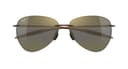
The numbers printed inside the temple arm (something like 54-18-140) are lens width, bridge width and temple length in millimeters. Measure a pair you own and like, then buy close to those numbers. Our size guide walks through it, and Maui Jim’s Sugar Beach on this list is here specifically because it is a genuine small fit rather than a scaled-down photograph.
Oversized frames: the one place bigger genuinely helps
There is a real functional argument for a larger lens, and it is not about style. The skin around the eyes is among the thinnest on the body, and both the AAO and the CDC recommend wraparound or oversized frames precisely because they cover more of it and block light arriving from the sides. An oversized frame that fits your face properly is doing more protective work than a small one.
The distinction that matters is oversized and correctly proportioned versus simply too big. The first covers your temples and eye area; the second slides down your nose all afternoon and ends up doing nothing. Which is, incidentally, the most common complaint we see — our guide to sunglasses sliding down has the six causes and the fixes.
What to spend
Under $20 buys a genuinely polarized, genuinely UV400 pair that you will not mourn when it goes missing at the beach — and given how often sunglasses are lost, that is a perfectly rational purchase rather than a compromise. Around $35 buys the same protection with better hinges and finish. Somewhere near $180 buys a heritage frame that will still look right in a decade. Above that, you are buying lens quality — a Maui Jim PolarizedPlus2 lens genuinely lifts color rather than only dimming the scene, and if you are outdoors constantly you will notice it every time.
What is never worth it is a mid-priced fashion frame with no stated UV rating. Our breakdown of what expensive sunglasses actually buy takes this apart in full, and our budget roundup covers the cheap end properly.
If you are over fifty, two things change that this ranking does not account for — glare tolerance and reading distance — and our best sunglasses for women over 50 page ranks on those instead, including the bifocal options no fashion frame carries.