The lens decision: 2.0mm polycarbonate or 1.0mm TAC
This is the only KastKing question that genuinely matters, and the brand answers it on its own pages if you read two of them side by side.
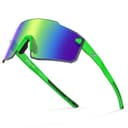
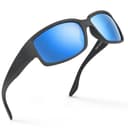
Polycarbonate at 2.0mm, which is what the Etowah uses, is the impact-resistant choice. Polycarbonate is the material safety eyewear is made from because it deforms rather than shattering, and 2.0mm is a genuinely thick lens — KastKing describes it as “impact-resistant 2.0mm PC lenses protect against flying objects”. On a boat, where a hook, a lure or a lead weight can arrive at your face at speed, that is the correct lens and the extra thickness is not a marketing number.
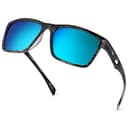
TAC at 1.0mm, which is what the FlatRock uses, is a laminated lens built in layers around a polarizing film. It is thinner and lighter on the nose, and KastKing’s own claim for the figure is that it is “comparable to the thickness you would find on much higher priced sports eyewear”. For driving, walking, a round of golf or a day where nothing is going to hit you, a thinner lens is more comfortable for longer, and the polarization works identically. For a deck, it is the wrong trade.
That is the whole decision, and it is worth saying that most brands will not let you make it, because most brands publish neither number. Our guide to glass versus polycarbonate lenses covers what each material gives up, and sunglass lens coatings covers what an oleophobic layer actually does and what it does not.
What KastKing publishes that premium brands do not
What each tint is for
Both pages we read list four tints with a stated use for each: smoke for bright sun, medium light and partial shade; brown for contrast and depth perception from cloudy to sunny; copper for moderate to low light; green for sunny through overcast. That is more tint guidance than several hundred-dollar brands put on a product page, and it is correct in direction — the warm tints do lift contrast at the cost of color neutrality. Our lens color guide is the full version, and it matters more on the water than anywhere else: for actually seeing into water, read the fishing roundup, and for seeing across it for hours, the boating roundup.
A named coating, and the limits of it
PuriVex is KastKing’s coating name, and on the Etowah page it is stated to repel water, oil, salt and dirt while resisting scratches. A water-repellent coating on a fishing lens is a real convenience: a drop of salt spray beads and runs rather than drying into a haze you then grind into the lens with a shirt. What we will not do is tell you it is unique technology; it reads like the hydrophobic and oleophobic layers most lens makers apply, and KastKing publishes no test data for it. The honest caveat is the one above: the FlatRock page, read the same day, names only an “oleophobic” coating and never mentions PuriVex, so the headline feature is not line-wide.
UV, and what the ANSI line means
Both pages state the lenses block 100% of harmful UVA and UVB rays and that they meet or exceed U.S. ANSI standards. The first claim is the one that matters for your eyes and it is the floor for anything we recommend here. The second is worth a caution: ANSI Z80.3 is the consumer sunglass standard covering UV and light transmission, while ANSI Z87.1 is the occupational impact standard, and a general “meets or exceeds all U.S. ANSI standards” sentence does not tell you which. Do not read it as a safety marking. If you need certified impact protection for work, the marking has to be stamped on the frame itself — our ANSI Z87.1 safety sunglasses page explains what to look for, and what UV400 means covers the UV half.
The questions people actually ask about KastKing
“KastKing vs Costa”
It is in the autocomplete for a reason, and the honest answer is that they are not really competing. Costa’s argument is its 580 glass lens and the optical performance of glass; KastKing has no glass lens and does not claim one. What a KastKing gives you is a correctly polarized, properly UV-rated, well-specified plastic lens at roughly a tenth of the price, which is the right object to own if losing a pair overboard would ruin your week. Costa also repairs and warranties its frames through a dealer network; KastKing states a 30-day money-back guarantee and a “Hassle-Free Warranty” whose duration its page does not give. Our Costa review and 580G versus 580P comparison are the other side of that trade, and are expensive sunglasses worth it is the general version of the question.
“KastKing for big heads”
The line is sport-wrap shaped, which generally runs wider than a lifestyle frame, and the Etowah is a one-piece shield that spans the whole face. But KastKing publishes no lens width, no bridge and no temple length for any model we carry, so we cannot tell you a number and will not invent one. If frame width is your deciding factor, buy from a listing that publishes measurements — our roundup for larger heads ranks on published width specifically, and the size guide explains how to read the three numbers.
“KastKing with readers”
This one KastKing answers better than almost anybody. The Waccamaw is a genuine bifocal sunglass — a magnifying segment set into the bottom of a polarized lens — sold in x1.5, x2.0 and x2.5, in a full wrap frame with real side coverage, which almost no sun reader has. If you tie knots and then look up across the water, that is the object. The whole category, including how to work out which power you need, is in the bifocal sunglasses roundup.
“KastKing cat 3”
We cannot answer this from KastKing’s data, and neither can anyone else honestly. A filter category is a 0–4 scale describing how much visiblelight a lens transmits, and KastKing publishes no category and no transmission percentage for any model we carry. A dark smoke lens on a sport frame is typically a category 3, which is the normal bright-sunlight band — but typically is not published, so the field stays empty on every card below. Our lens category guide explains the scale and, importantly, why a category number is not a UV rating.
Who should buy a different brand
If you want the sharpest possible lens and the price is secondary, KastKing is not it — that argument belongs to glass, and Costa versus Maui Jim is where it gets settled. If you want a frame that looks right with something other than fishing clothes, the line is sport-shaped throughout and a wayfarer or a rectangular frame is the better buy. If you want the cheapest competent polarized pair and do not care about the water at all, Knockaround and goodrare reviewed here too and both cost less than the Etowah. And if you need a prescription, nothing in this line can be glazed — prescription sunglasses is the route.