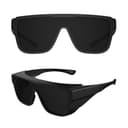
The one thing not to do: wear dark lenses indoors
This is the most important part of the page, and it runs directly against instinct. The AAO’s own published discussion of photophobia carries a clear warning from a specialist in the field: people who wear really dark glasses can actually dark-adapt themselves and increase their photosensitivity. Sunglasses outside are fine — but the darker the glasses worn inside, the more light-sensitive the person becomes.
The mechanism is straightforward. Spend your indoor hours in artificial darkness and your visual system recalibrates to that lower level, so ordinary indoor light then feels excessive, so you wear the glasses more. It is a self-reinforcing loop, and it is common enough that clinicians look for it specifically.
The practical rule that follows: wear sunglasses outdoors, take them off indoors, and if indoor light is genuinely intolerable, that is a reason to see a specialist rather than a reason to buy a darker lens.
What actually helps
1. Coverage does more than darkness
For light sensitivity specifically, where the light comes from matters as much as how much of it there is. Light arriving around the edges of a frame — from the sides, from below off pavement, from above around the brow — is often what triggers the discomfort, and a very dark lens with gaps around it does not address any of it.
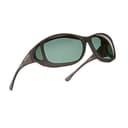
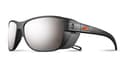
This is why the picks on this page are wraparound and fit-over styles rather than dark fashion frames. The AAO recommends wraparound designs generally for the same reason, and for a light-sensitive wearer the benefit is larger. A moderately tinted lens that seals the gaps consistently outperforms a very dark one that does not. Our base curve and wrap guide covers the geometry.
2. Tint color, and what FL-41 actually is
FL-41 comes up constantly in this context and is worth explaining accurately. It is a rose-pink tint, originally formulated for fluorescent-light sensitivity, and the AAO describes it as a mixture of colors that blocks the blue-green wavelengths. It is used clinically as an adjunctive option for light-sensitive patients, including in benign essential blepharospasm and in some migraine contexts.
Two honest caveats. First, FL-41 is a tint specification rather than a brand, and the AAO discussion notes that some lenses can look like FL-41 without acting like it — clinicians doing this properly run spectral analysis to confirm the lens is blocking the right band. A pink lens from a general retailer is not the same product. Second, we do not stock or recommend a specific FL-41 lens here, because verifying that a listing’s tint performs as claimed is not something we can do from published specs. If FL-41 is what you want, get it through an eyecare practitioner who can source a verified lens.
For general outdoor use, a rose, amber or brown tint tends to be more comfortable for light-sensitive wearers than a neutral gray, because it reduces the short-wavelength light that scatters most inside the eye. Our lens colors guide covers each tint’s behavior.
3. Gradient tints have a specific, clinician-suggested use
The AAO’s patient-facing guidance notes that people with light sensitivity can often be helped by tinted lenses, or by gradient tints in which the upper portion of the lens is considerably darker than the lower portion.
The logic is that most of the offending light arrives from above — the sky, overhead lighting — while the lower part of your field contains the things you need to see clearly: a book, a phone, a dashboard, the ground in front of you. A gradient shades the first without dimming the second. It is one of the few cases where a feature usually sold as styling has a considered functional rationale.
4. Choose the lens category deliberately
Category 3 covers ordinary bright sun and is where most quality sunglasses sit. Category 4 transmits under 8% of visible light and exists for glaciers and high altitude — and for a genuinely light-sensitive wearer in very bright conditions it can be the right tool, which is why two category 4 options appear on this list.
The hard limit: category 4 lenses are not legal for driving in many places, and they are genuinely unsafe for it. They are a tool for the brightest hour of the brightest day outdoors, not a general-purpose lens. Our lens categories guide explains the scale and where each band belongs.
5. Polarization helps with the glare component
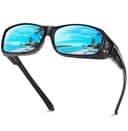
If your sensitivity spikes specifically around water, wet roads, snow or bright pavement, a large part of what you are reacting to is reflected glare rather than ambient brightness. Polarization removes that specifically, and it does so without making the lens darker — which, given everything above, is exactly the kind of trade you want.
Our polarization guide explains the mechanism, and the home test will tell you what a pair you already own is doing.
6. Fit-overs are the practical answer if you wear glasses
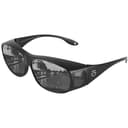
Most people managing light sensitivity already wear a prescription, and a fit-over solves two problems at once: it goes over your existing glasses, and it is built with the side and top coverage that a slim prescription sunglass frame will not give you.
They are not subtle. That is the trade, and for a symptom that genuinely affects your day it is usually the right one. Our fit-over roundup covers the category more broadly, and our clip-on roundup covers the lighter alternative — though clips give you no side coverage, which is the thing that matters most here.
When light sensitivity is a reason to see a doctor
Worth listing plainly rather than burying. See an ophthalmologist promptly if light sensitivity is new or rapidly worsening; affects one eye more than the other; comes with eye pain, redness, or discharge; follows an injury or eye surgery; or arrives alongside headache, nausea or visual disturbance. Refractive surgery is the common planned case: light sensitivity and glare are both listed effects of LASIK, which the AAO notes may be temporary or permanent, and our guide to sunglasses after LASIK sets out that timeline with the eyewear decisions it implies.
The AAO notes that photophobia occurs with inflammation inside the eye and with a range of corneal and retinal conditions, and that identifying and treating the underlying cause is the primary step. Increased glare sensitivity is also among the early symptoms of cataract — our night driving guide covers that overlap, since night glare is often where people notice it first.
Where to spend and where not to
Spend on coverage and on a fit that seals the gaps, because that is the variable that changes how the day feels. Spend on polarization if glare off reflective surfaces is your trigger.
Do not spend on darkness for its own sake, and do not wear a dark lens indoors chasing relief — on the AAO’s own account that makes the underlying sensitivity worse over time. And do not spend on a lens sold as FL-41 by a general retailer without a way to verify it; that is a purchase to make through an eyecare practitioner. The fit hub has the rest of the fitting guides, and our UV protection guide covers the specification that matters regardless of tint.