At a glance
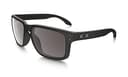
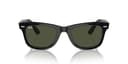
| Wayfarer (RB2140) | Holbrook (OO9102) |
|---|
| Frame material | Acetate | O Matter (nylon) |
|---|
| Lens material | Crystal / glass (G-15) | Plutonite (polycarbonate) |
|---|
| UV | 100% UV protection | 100% UV to 400nm, from the material |
|---|
| Polarized as standard | No — polarized SKU sold separately | No — Prizm and polarized SKUs sold separately |
|---|
| Standard tint | G-15 green | Warm Gray |
|---|
| Suits | Round and oval faces | Round and oval faces; sport crossover |
|---|
| Larger fit available | New Wayfarer and 2140 in two lens widths | Holbrook XL (59mm), Asian Fit |
|---|
| Impact behaviour | Glass lens: clearer, heavier, can shatter | Polycarbonate: lighter, impact-resistant |
|---|
| Owned by | EssilorLuxottica | EssilorLuxottica |
|---|
That last row is not a typo, and it is worth sitting with. EssilorLuxottica lists both Ray-Ban and Oakley among the brands it owns outright. You are choosing between two product philosophies inside one company, not between two competitors — which is the subject of our designer sunglasses page and part of why the prices look the way they do.
The lens: glass clarity against impact safety
This is the one genuine engineering difference. The Wayfarer’s standard G-15 is a crystal lens: optically excellent, scratch-resistant in normal use, and heavier. The Holbrook’s Plutonite is a polycarbonate: lighter, far more impact-resistant, and softer, so it scratches more easily if you are careless. Neither is “better” — it is the trade our glass vs polycarbonate page sets out in full, and it is the same decision as Costa 580G against 580P.
For UV the two are equivalent, and both are what you want: 100% blocking. Oakley’s version has a structural advantage worth knowing about — the filtering comes from the Plutonite material rather than from a surface coating, so it holds across every tint and cannot be worn off. In practice the AAO’s position is that any lens stating 100% UV or UV400 is doing the job, and that a darker tint is not more protective. Our UV page covers the labels and what they mean.
Polarization: the detail that changes the purchase
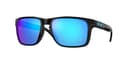
Both frames, in the trim most retailers show first, are not polarized. The Wayfarer’s standard G-15 is a plain tint; the Holbrook’s base SKU is a non-polarized warm grey. Both brands sell polarized versions of the same frame at a higher price, and the Holbrook XL trim we carry is a mirrored Prizm Sapphire — which looks reflective and still is not polarized. Mirroring and polarization are unrelated, as our mirrored lenses page explains.
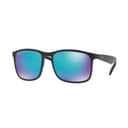
So if your complaint is glare off a road, a bonnet or water, neither of these at list price solves it, and a budget polarized pair from our under-$100 roundup does. Check the SKU before you buy — this is the single most common mistake in this comparison, and our four-test page shows how to prove what you actually received. If you want the badge and the polarized lens, the RB4264 Chromance is Ray-Ban’s answer, and it is on this page for that reason.
Fit: the same advice, different sizes
Both are squared frames, so both do the same thing to a face: they add definition, which suits rounder and softer features and can over-emphasise an already angular jaw. Our face-shape guide has the rule, and round faces and square faces have the picks.
Where they differ is what happens when the standard size is wrong. Oakley publishes a proper answer: the Holbrook XL with a 59mm lens and a longer front, plus an Asian Fit with a raised bridge for low nose bridges. Ray-Ban’s equivalent is choosing between lens widths and between the Original and New Wayfarer, which is a smaller adjustment. If a standard frame pinches your temples, that difference is decisive — see sunglasses for big heads.
Durability and what happens when something breaks
An acetate frame is hand-assembled, repairable by an optician, and will relax and go soft if you leave it on a car dashboard. A nylon sport frame shrugs off drops and does not adjust as readily. For most people the Holbrook is the more survivable object and the Wayfarer is the more serviceable one. Which Holbrook to buy is its own question, and our Oakley Holbrook review answers it across the three fits we carry.
Both carry a manufacturer warranty against defects, and neither covers scratched lenses — nobody’s does, which our repairs and re-lensing page covers along with what a replacement lens actually costs. At these prices, re-lensing is usually the right answer to a scratch rather than replacing the frame.
The verdict
Buy the Holbrook if you want one frame for several jobs, if you are hard on sunglasses, if you need a larger or a low-bridge fit, or if you want the option of stepping up to a Prizm or polarized lens later. It is usually the cheaper of the two as well — the live prices are in the table above.
Buy the Wayfarer if the styling is the point. It is the most copied frame shape ever made, the glass lens is genuinely lovely to look through, and it is the pair you will still want in a decade. Our Wayfarer roundup covers the polarized alternatives at every price, and Wayfarer vs Aviator is the other half of this decision if you have not settled on a shape.
Buy neither if what you want is glare control for the money. Our under-$100 roundup and honest answer on price both make the case that UV protection costs almost nothing and polarization costs very little — and that at premium-frame money you are buying a frame, not a lens upgrade. For the brand-level version of this argument, see Oakley vs Ray-Ban.