How to choose sunglasses for a heart-shaped face
1. Keep the top of the frame light
The single most common mistake is a frame with a thick, dark, heavy top rail — a bold browline or a chunky square acetate. On a face that is already widest at the brow, that adds mass exactly where you do not need it and makes the chin look narrower by contrast.
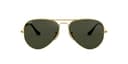
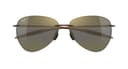
The fix is thin metal, a rimless or semi-rimless construction, or an acetate frame with a genuinely slim top edge. A thin frame reads as light regardless of how large the lens is, which is why a big aviator works and a smaller heavy square does not.
2. Put the visual weight low
Shapes with their mass at the bottom balance a heart-shaped face by drawing the eye downward. In practice that means:
- Aviators and teardrops — the lens narrows toward the bottom, which echoes and softens the taper of the face.
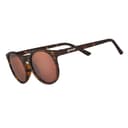
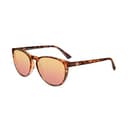
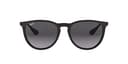
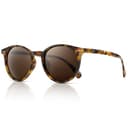
- Round frames — a circular lens has no upward point at all, and the curve softens a strong brow and a pointed chin at the same time.
- Bottom-heavy and downswept shapes — anything with more depth below the pupil line than above it.
3. Do not go wider than your temples
Because a heart-shaped face is already broad at the top, an oversized frame that extends past the temples exaggerates it. Match the frame width to your temple width rather than to your cheekbones — which is the opposite of the advice for an oval or round face.
The measurements printed inside the temple arm are how you check this without trying the frame on; our sunglasses size guide explains how to read a string like 54-18-140 and how to measure a pair you already own.
4. Two shapes to be careful with
Upswept cat-eyes. The whole design points outward and upward at the temples, which is a correction for a face that needs lifting — a round or square one. On a heart-shaped face it doubles down on the widest part. It can be done deliberately as a strong look, but it is not a flattering default. Our cat-eye roundup covers where the shape genuinely helps.
Heavy square browlines. Same problem, more literally: a thick horizontal bar across the top of your face, at the widest point. If you love the shape, look for a version in thin metal rather than thick acetate.
5. Check the bridge before anything else
Heart-shaped faces frequently pair with a narrower nose bridge, and a bridge that is too wide is the number-one cause of sunglasses sliding down. If every pair you own creeps down your nose, the fix is a narrower bridge measurement or adjustable nose pads rather than a different shape — our guide to sunglasses sliding down covers the six causes, and our low nose bridge guide covers the alternative-fit frames built for exactly this.
The lens still matters more than the shape
Every fit guide gets absorbed in silhouette and forgets that you are buying a lens. Before you commit to a frame because it flatters, confirm two things.
UV. A stated UV400 or 100% UVA/UVB claim. The American Academy of Ophthalmology is explicit that neither lens darkness nor price predicts UV protection, and Prevent Blindness advises buying only sunglasses that carry a clear statement of UV blocking. Our UV protection guide covers the label wording.
Polarization, if you drive a lot or spend time near water. Note that the base version of several heritage frames — including the classic Aviator on this list — is not polarized, and the polarized SKU costs more. Our polarized vs non-polarized comparison covers whether you need it.
Am I actually heart-shaped?
Pull your hair back and compare three widths in a mirror: forehead, cheekbones, jaw. A heart-shaped face has the forehead as the clear widest point, cheekbones slightly narrower, and a jaw that tapers noticeably to a small or pointed chin. A widow’s peak is common but not required.
If your forehead and jaw are close to the same width and the jaw is squared off, you are closer to a square face — see our square-face picks, where the advice inverts entirely. If everything is roughly balanced, our oval-face picks apply. The full method for every shape is in our face-shape guide.
Where to spend and where not to
The thing worth paying for on this face shape is frame construction, specifically thin metal that holds its shape. A cheap thin metal frame bends at the temple and the bridge, and a bent frame sits crooked on a face where symmetry is doing the work. That is a genuine argument for a mid or premium metal frame if you plan to wear it daily.
What is not worth paying for is UV protection, which is essentially free at every price point — our honest answer on expensive sunglasses covers the rest of what the money buys. For the whole range of fit questions, our fit hub has size, slippage and face-shape guides, and our women’s roundup and men’s roundup cover the broader everyday picks.