Why curves work on a square face
Sunglasses sit across the widest, most-read part of your face, and whatever geometry they carry becomes the dominant line in the picture. On a face with a strong jaw and a broad, flat brow, adding a rectangular frame means three strong horizontals stacked on top of one another — brow, frame, jaw. Nothing in that arrangement gives the eye anywhere to rest.
A curved frame breaks the stack. The circle or oval introduces the one thing your face does not already have, and because contrast is what the eye notices, the effect reads as softening rather than as a shape you are wearing. The stronger the jaw, the stronger a curve you can carry.
There is a proportion rule underneath this too. Because a square face is broad, you want a frame with enough width to span it — a small round frame on a wide face reads as two dots rather than as balance. Aim for a total frame width close to the width of your face at the temples, then choose the roundest shape you are comfortable with at that size.
The shapes, ranked for a square face
1. True round — the strongest counterweight
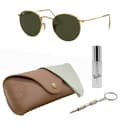
A perfect circle is the most effective thing you can put in front of an angular face, because it shares no line with anything already there. The Ray-Ban RB3447 Round Metal is the reference version: thin metal, no brow bar, unmistakably circular. It is also a committed look — if you want the effect without the statement, drop to the next option.
2. Teardrop aviator — the wearable compromise
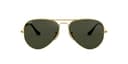
The aviator is a rounded shape that narrows toward the bottom, which softens the jaw without going fully circular, and its wide lens spans a broad face well. It is the safest recommendation on this page: nobody has ever looked at an aviator and thought it was a strange choice.
3. Soft oval and rounded-square — the everyday middle
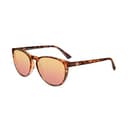
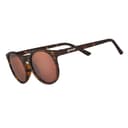
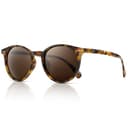
An oval or a squared frame with genuinely rounded corners still breaks the horizontal lines while reading as conventional. This is where most of the budget picks on this list sit, and for a lot of people it is the sweet spot between flattering and unremarkable.
4. Cat-eye — a good option with a caveat
The upswept outer corner lifts and draws attention away from a heavy jaw, which works well on a square face — provided the frame is rounded rather than sharply angular at the corners. A very geometric cat-eye adds angles you do not need. Our women’s roundup has cat-eye picks that stay on the soft side.
What to avoid
- Hard rectangles and sharp squares. A boxy Wayfarer-style frame is wonderful on a round face and the wrong tool here. If you love the shape, look for a version with rounded corners and a thinner front.
- Heavy, thick acetate fronts. Weight in the frame adds visual weight to a face that already has it. Thin metal and light acetate flatter more.
- Sharp angular brow bars. A strong horizontal across the top of the frame lines up with a broad forehead and emphasizes it.
- Frames narrower than your face. This is the most common mistake and it is a sizing issue rather than a shape one — a frame that stops short of your temples makes a broad face look broader. Our size guide covers how to measure properly.
Get the size right, or none of this matters
Shape advice only works at the correct scale. The three numbers printed inside the temple arm — something like 54-18-140 — are lens width, bridge width and temple length in millimeters, and they are the fastest reliable way to buy a frame that fits without trying it on. Measure a pair you already own and like, and buy within a couple of millimeters.
Two specifics for a square face. First, total frame width should roughly match your face width at the temples; a broad face usually needs a lens width at or above 54mm. Second, watch the bridge: if your sunglasses habitually slide down, the bridge is probably too wide for your nose rather than the frame being too big overall, and our guide to that problem has the fixes. If standard frames pinch at the temples, start with our wide-face roundup instead.
Lens spec still comes first
None of this overrides the basics. Every pick here states UV400 or 100% UV protection, because a dark lens with no ultraviolet filter is worse for your eyes than none at all — the tint opens your pupil while letting UV through. And five of the six are genuinely polarized, which is the feature you will actually notice day to day on wet roads and bright water.
Worth flagging on one pick: the Ray-Ban RB3447 is sold with both polarized and non-polarized lens options and the listing does not always make it obvious, so read the colorway if glare control matters to you. Our one-minute polarization test settles it once the pair is in your hands, and our UV protection guide covers the labeling.
For the full fitting framework across all four face shapes, our face-shape guide is the pillar page, and the fit guide hub has the rest.