What ANSI Z87.1 actually certifies
ANSI/ISEA Z87.1 is the American National Standard for occupational and educational eye and face protection. OSHA’s general-industry rule on eye and face protection (29 CFR 1910.133) requires protectors to comply with it — specifically ANSI/ISEA Z87.1-2010, Z87.1-2003 or Z87.1-1989 (R-1998), or to be demonstrably as effective.
The standard is about mechanical performance. It defines impact tests — a high-mass drop test and a high-velocity projectile test — that the lens and frame must survive without shattering, without the lens being displaced from the frame, and without contact with the eye. It also covers optional protections for splash, dust and optical radiation, and it requires the eyewear to be permanently marked so an inspector can identify it.
Reading the markings
A Z87.1-compliant pair carries markings on the frame and often on the lens. The core ones to recognize:
- Z87 — meets the basic impact requirement.
- Z87+ — meets the higher-velocity impact requirement. This is the one you want for grinding, chipping or anything that throws fragments.
- A manufacturer’s mark — the maker’s logo or identifier, which is what makes a counterfeit detectable.
- A shade or filter designation where the lens is tinted for a specific radiation hazard, such as welding.
If a lens is unmarked, it is not certified eyewear regardless of what the listing says. That is also the simplest counterfeit check — our guide to spotting fake sunglasses covers the same reasoning for branded eyewear.
Why Z87.1 says nothing about UV
This is the single most important thing on this page. Impact certification and ultraviolet protection are unrelated. A lens can be Z87+ rated and pass every impact test while blocking very little UV, and a $15 pair of ordinary sunglasses marked UV400 can block all of it while shattering on the first impact.
Worse, the two failure modes compound. A dark tinted lens makes your pupils open wider. If that dark lens has no UV filter, more ultraviolet reaches the back of the eye than if you wore nothing at all — which is why the American Academy of Ophthalmology stresses that lens darkness is not a proxy for protection. Our UV protection guide covers what the labels mean and what to look for.
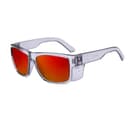
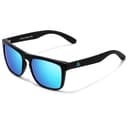
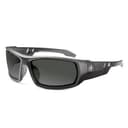
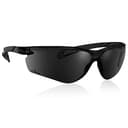
Practical rule for buying: you want the listing to state both a Z87 or Z87.1 mark and a UV figure — UV400, or 100% UVA/UVB. Two of the picks above do. Three state the impact rating and stay silent on UV, and we have flagged that on each rather than filling in a number we cannot verify.
How to choose
1. Match the impact rating to the actual hazard
Basic Z87 covers general impact. Z87+ covers high-velocity impact and is what you want around grinders, saws, powder-actuated tools and anything that produces fragments at speed. If your work is landscaping, roofing, surveying or driving, basic Z87 with a good UV rating is a sensible balance. If you are cutting metal, do not compromise on the plus.
2. Decide whether you need side shields
Many sites require side protection, which is why removable side shields appear on two of these picks. They are also genuinely useful for reflected UV in high-glare environments — concrete, water and sheet metal all throw light back at you from the side. The removable design is the sensible compromise: on for the site, off for the drive home.
3. Polarization for reflected glare
If your workday involves wet concrete, glass, water or bright sheet metal, a polarized lens is a genuine comfort and safety improvement — it removes the horizontally reflected light that makes those surfaces glare white. The trade-off is that polarized lenses can black out some LCD screens and machine displays at certain angles, so check your own equipment first. Our polarized vs non-polarized comparison covers this properly.
4. Anti-fog matters more than you expect
If you work in a dust mask or respirator, warm exhaled air goes straight up behind the lens. An anti-fog coating is the difference between eyewear you keep on and eyewear you push up onto your head — at which point it is protecting nothing. Every pick here with anti-fog says so.
5. Fit, because badly-fitting PPE gets removed
The most common reason people stop wearing safety eyewear is that it rides up when they look down at their work. Adjustable or self-adjusting temples fix that. So does a nose pad that actually matches your bridge — if the frame sits on your cheeks or slides, our guide to sunglasses sliding down has the same fixes, and the frame size guide explains the measurements.
Safety sunglasses are not sport eye protection
One boundary worth drawing. Prevent Blindness states plainly that occupational safety glasses do not provide adequate protection for sport — ball and racket impacts are a different energy profile, and what protects against them is a sport eye guard meeting the relevant ASTM standard for that sport. So Z87.1 for the job site, ASTM sport eye guards for the court. Our pickleball roundup makes the same point from the other direction.
Where to spend and where not to
Not much, but spend it in the right place. The premium end of this category is about thirty dollars, and what it buys is the combination — certification, UV400 and polarization on one pair. That is worth paying for, because the alternative is carrying two pairs and using the wrong one.
At the bottom, a certified tinted pair costs less than lunch, which is exactly right for eyewear that will get sat on, dropped from a ladder and left on a roof. Buy three. For eyewear that is about riding rather than working, our motorcycle roundup covers the same Z87.1 frames with a wind seal, and the sport hub has the rest.