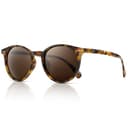
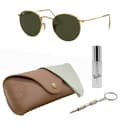
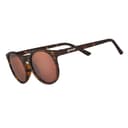
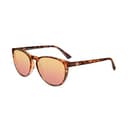
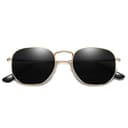
How to choose a round frame
1. Check polarization, because the category default is no
Round frames descend from a heritage-metal tradition where the lens was a crystal tint rather than a polarizing filter, and the modern fashion end of the category has inherited that without inheriting the optical quality.
So this is the first spec to check, not the last. Polarization removes light reflected off flat horizontal surfaces — water, wet road, a car hood — which the AAO describes as reducing glare from reflective surfaces. Two picks here deliver it for under $30, which reframes the whole category: if glare control is what you want, you do not need to spend. Our polarized vs non-polarized comparison covers the trade, and the home test settles what you already own.
2. UV is separate, and non-negotiable
Polarization tells you nothing about ultraviolet — they are unrelated properties, as our answer on the subject explains. Look for a stated 100% UV, 100% UVA/UVB or UV400 claim, all of which mean the same thing.
In this category especially, a frame that will not state a figure should be treated as one that does not know. The AAO is explicit that a dark lens without UV filtering is worse than no sunglasses at all, because darkness opens your pupil while letting the ultraviolet through. Our UV protection guide covers the labels, and our UV testing guide covers what to do when a listing is silent.
3. Know which faces the shape suits
A round frame works by contrast, and its contrast is softness. That gives a clear hierarchy:
- Square and strongly angular faces:the shape’s best case. Curves balance a defined jaw where more angles would emphasize it. See best sunglasses for a square face.
- Diamond faces: excellent, because a round lens curves away from a wide cheekbone rather than sitting across it. See our diamond face guide.
- Long and oblong faces: a large round frame is as tall as it is wide by definition, which is exactly the proportion a long face lacks. Go big rather than small. See our long face guide.
- Heart-shaped faces: works well, particularly the smaller versions, because it balances a wider forehead against a narrower chin. See our heart face guide.
- Round faces:the one to be careful with. A round frame on a round face echoes rather than balances. If you love the shape, choose a version with some angle — a hexagonal or softened-geometric frame gets you most of the look with corners to do the work. That is why one such pick is on this list. See our round face guide.
Our face shape guide has the measuring method if you are unsure.
4. Size changes the shape's meaning entirely
More than any other silhouette, a round frame reads completely differently at different sizes. A small round lens on a thin metal frame is a specific, deliberate look. A large round frame is a different garment altogether — softer, more casual, and far more forgiving on a long face.
The practical consequence is that photographs mislead more here than elsewhere. Use the lens-width number rather than the picture: the first of the three figures printed inside a temple arm. Our size guide explains how to read them and how to buy from a pair you already own.
5. Small round frames give you the least coverage of any shape
A genuine functional drawback and the reason we would not choose a small round frame for a beach day. A small, flat, circular lens leaves gaps everywhere — above the brow, below the cheekbone and, most importantly, at the sides, which is where reflected ultraviolet arrives from off water, sand and snow.
The AAO recommends wraparound styles where sun exposure is the main event, and the FAA makes the same point about small lenses from an aviation angle: frame styles with small lenses may not be practical because they allow too much visible light and UV radiation to pass around the edges of the frame. Wear a small round frame in town; take something wrapped to the water. Our base curve and wrap guide covers the geometry and our beach roundup covers the alternative.
6. Metal or acetate changes how it ages
The heritage round frame is thin metal with adjustable nose pads, which is a real advantage: an optician can adjust the pads to your face, and the pads themselves stop the frame resting on your cheeks. The drawback is that thin metal bends, and metal corrodes in salt air.
An acetate or injection-molded round frame is more robust and cannot be adjusted at the bridge. Neither is better; they fail differently. Our frame materials guide covers the comparison.
Where to spend and where not to
Spend on the frame if you want the heritage metal look and expect to keep it for years — that is a genuine product, adjustable and repairable, and there is no cheap substitute for it. Our Ray-Ban review covers what the premium buys.
Do not spend on a round frame expecting better lenses. On the specification that protects your eyes, the $25 polarized UV400 picks on this list and the premium ones are equivalent — the AAO is direct that price is not a proxy for protection, and our answer on expensive sunglasses covers where the money actually goes. For the other heritage shapes, see our aviator roundup and wayfarer roundup; the everyday hub has the rest.