The three builds, and how to pick one
Drilled rimless: the real thing, and the fragile one
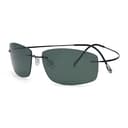
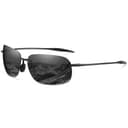
A drilled rimless frame is two lenses with holes bored through them, a bridge spanning between, and the arms bolted on at the outer edges. Nothing surrounds the lens. It is the lightest and least visible way to put a tinted lens in front of your eye, and it is also the only build where the structural load runs throughthe lens rather than around it. Two things follow. First, the frame material matters more here than in any other build — it is carrying the whole frame on two thin arms, which is why the titanium pick is first and why we would not buy a drilled rimless in unnamed plated metal at any price. Second, the lens material matters for a reason it does not elsewhere: a drilled hole concentrates stress, and a brittle lens cracks from the hole outward.
That second point is where the category gets frustrating. The Eyekepper listing names the frame material and will not name the lens material, so the one spec that tells you whether the drill holes will hold is the one you cannot read. Our guide to sunglass frame materials covers what titanium, TR90 and acetate actually do differently, and glass versus polycarbonate lenses explains why the lens material is a durability decision and not only an optical one. The short version for this page: a drilled rimless with a glass lens is a bad idea, and a drilled rimless that will not tell you what its lens is made of deserves a hard case.
One-piece rimless: the best field of view you can buy
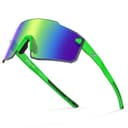
A one-piece rimless replaces both lenses and the bridge with a single curved or flat lens, with the arms screwed to its outer edges. There is no frame line anywhere in your view — not even at the nose, which is the one place every other build puts something. If your reason for wanting rimless is the view rather than the look, this is the build that delivers it, and the KastKing Etowah is the pick: a single piece of 2.0mm polarized polycarbonate with Grilamid temples, which is the only published lens thickness anywhere on this page.
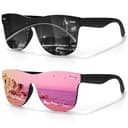
The two catches are real. A one-piece lens cannot be made to a prescription and cannot be replaced on its own, so a deep scratch retires the whole pair — which is why the included hard case matters more than it sounds. And the base curve decides how much side coverage you get: the Etowah is a wrap, so it curves around and blocks light at the temples, while the flat LINVO one-piece is essentially a visor held straight across your face and lets light in at the sides. That difference is covered in full in our guide to base curve and wrap, and it is the same geometry argument behind single-lens shield sunglasses, which take the one-piece lens and put a full frame around it.
Semi-rimless: what most people actually want
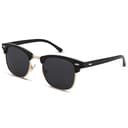
A semi-rimless browline keeps a metal brow across the top of the lens and leaves the bottom edge open. Look at where your own eyes go: you do not look up through the top of your lenses, you look ahead and down. A top rim is therefore nearly invisible in use while doing most of the structural work, and the open bottom edge is what gives a semi-rimless its light, unframed feel. It is the most durable of the three builds, the easiest to find polarized, and — in the Pro Acme pick here — the cheapest by a wide margin.
We rank it second rather than first only because somebody searching for “rimless” may specifically want nothing above the lens either. If that is not you, buy the semi-rimless and keep the difference. The browline shape is also a face-shape decision in its own right: a strong horizontal brow line adds width and definition at the top of the face, which suits rounder and softer faces and competes with a strong brow. Our face-shape guide and sunglasses size guide cover that, and rectangular frames are the closest full-rim equivalent if you decide you want the structure after all.
What rimless costs you, in order of how much it matters
Coverage
This is the one with a health argument behind it rather than a preference. Ultraviolet light reaches the eye from the side and from above as well as straight on, and the American Academy of Ophthalmology’s own guidance is to choose wraparound or oversized frames so light cannot arrive around the lens. A rimless frame tends to be smaller and flatter than a full-rim sport frame, so it covers less. Two of the picks here answer that properly — the Etowah wraps, and the FAGUMA TR90 is a sport shape — and the flat one-piece and the browline do not. None of that changes the UV rating of the lens itself: all six picks state UV400 or 100% UVA/UVB, which is the floor for anything we will recommend. It changes how much of the light entering your eye passes through that lens at all. If maximum coverage is your priority, read wraparound sunglasses instead, and UV protection for what the rating does and does not promise.
Durability
A rim is edge protection. Without one, a drop that lands lens-down is a permanent chip rather than a scuffed frame, and on a drilled frame the screws are a second failure point that full-rim frames simply do not have. Budget a case, actually use it, and expect to tighten a screw occasionally — our guide to storing sunglasses is more relevant to this category than to any other on the site, and repairs and replacement lenses covers what can and cannot be fixed. The honest summary: a drilled rimless can usually be repaired, and a one-piece rimless usually cannot.
Prescription options
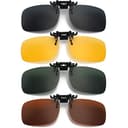
Drilled rimless frames are a long-standing prescription format and an optician can glaze them, though lens material and thickness limits apply because the lens has to take a drill hole. One-piece rimless frames cannot be glazed at all. If you wear glasses daily and want the rimless look, the cheapest good route is not on this page as a pair of sunglasses — it is the Hifot flip-up clips, which are themselves rimless and go over the frames you already own. The two routes are compared in clip-on versus fit-over, with the full options in prescription sunglasses and the clip-on roundup.
What we would not buy
A rimless listing that does not state a UV rating. Two frames we would otherwise have ranked here — a well-reviewed JULI TR90 rimless sport frame and a cheap two-pack — were dropped from this page for exactly that, because a frame with no stated ultraviolet figure cannot be recommended on this site no matter how good the shape is. Also not: a drilled rimless in unnamed metal, where the arms are the structure and the metal is a mystery; and not a mirrored rimless as a first pair, because a mirror coating shows scratches more than a plain tint and this is the one build with nothing guarding the lens edge. Our pages on what UV400 actually means, whether sunglasses can damage your eyes and mirrored lenses cover all three.
About the weights nobody publishes
It is worth stating plainly, because it is the strangest thing about shopping this category. Rimless frames are sold on lightness. Product titles say “Ultra Lightweight” and “Ultralight”, brand pages say “super lightweight”, and across all six picks on this page — including the two whose maker publishes a full spec sheet with lens thicknesses in it — not one publishes a weight in grams. Every weight field on every card below therefore reads “Not published”. We could estimate; a titanium rimless is obviously lighter than an acetate wayfarer. We will not, because an estimate in a spec table is indistinguishable from a measurement to the person reading it, and this site exists to be the one that does not do that.