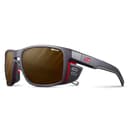
How to choose mountain bike sunglasses
1. Photochromic solves the defining problem of trail riding
Riding through trees means the light changes constantly — bright gap, deep shade, bright gap — often several times a second on a fast descent. Your pupils cannot keep up with that, and a fixed tint is by definition wrong for half of it. Too dark in the trees and you cannot read the trail surface; light enough for the trees and you are squinting in the open.
A photochromic lens is not a marginal upgrade here in the way it is for road riding. It is the answer to the sport’s central optical problem. Two limits worth knowing: photochromics are triggered by ultraviolet, so they respond to the sky rather than to the canopy directly overhead, and a polarized photochromic never returns to fully clear. Our photochromic guide covers both, and our photochromic vs polarized comparison covers which to choose if you can only have one.
2. Ventilation matters more than it does on the road
This is the difference riders notice first. On a road bike you are moving fast enough that airflow keeps the lens clear almost regardless of design. On a fire-road climb at walking pace in still air, you are producing maximum heat and getting minimum airflow — the worst possible fogging conditions.
What helps: vents cut into the top of the lens or the frame, a frame that holds the lens slightly off your brow rather than sealing against it, and a hydrophilic nose piece that keeps the lens from settling onto your face as you sweat. What does not help is a big sealed shield, however good it looks on a descent.
3. Impact resistance is a real requirement, not a spec-sheet line
Branches at eye height are the ordinary hazard of trail riding, and a stick in the eye is one of the more common serious injuries in the sport. Polycarbonate is the right lens material: it is the most impact-resistant lens material in general use and it does not shatter into fragments.
Be precise about what that does and does not mean. Polycarbonate is a safety advantage; it is not a certified impact rating, and Prevent Blindness is explicit that ordinary sunglasses are not sports eye protection. For downhill and enduro riding, where speeds and consequences are higher, goggles worn with a full-face helmet remain the right answer. Our safety sunglasses guide covers what a rated lens involves.
4. Check it against your actual helmet
Mountain bike helmets sit lower at the back and often lower at the brow than road helmets, and many now have a peak. Two things go wrong. A frame with tall temple arms can foul the helmet retention cradle, pushing the glasses down your nose over a ride. And a peak plus a large frame can leave you looking at the underside of the peak rather than at the trail when you get into a descending position.
If you ride with a peak, favor a frame with a lower profile at the top of the lens. Also check you can stow the glasses in the helmet vents, because you will take them off on long climbs and you need somewhere to put them.
5. Polarization is genuinely contested on a trail
On the road, polarization is broadly good: it kills glare off wet tarmac and car hoods. On a trail, opinion divides for a real reason. Polarization removes reflected light, and some of that reflected light is how you read a surface — the sheen that tells you a root is wet, or the glint off a wet rock. A number of experienced riders deliberately avoid polarized lenses for that reason.
Our position: if you ride mostly in dry conditions or near open water, polarized is fine and comfortable. If you ride wet, technical, rooty trails, an unpolarized photochromic is the safer choice. Our polarized vs non-polarized comparison covers the general case, and our road cycling roundup covers where the balance lands on tarmac.
6. Coverage, and the peripheral-clarity cost of getting greedy
You want enough wrap to keep dust, grit and wind out at speed, and enough for the lens to follow your cheekbone. What you do not want is the most aggressively wrapped lens available, because a steeply curved lens is optically harder to keep true at the edges, and mountain biking is a sport played in the periphery — you are reading a line several meters ahead and to the side, not looking straight forward.
The trade is real and measurable. The optical trade press notes that high-wrap frames typically need 8-base lenses and that the prescription is less true toward the periphery as the eye rotates. Our base curve and wrap guide explains the geometry.
Altitude changes the math
If your riding involves alpine trails rather than local woods, the ultraviolet dose rises substantially with elevation — the FAA puts the increase at roughly 5% per 1,000 feet, which is the same physics whether you are in a cockpit or on a col. Add snow patches or bare rock reflecting it back and a category 3 lens can stop being enough.
That is the case for the alpine pick on this list, which reaches category 4 darkness when it needs to. Note that category 4 lenses are not legal for driving in many places, so a lens with that range is a mountain tool rather than a do-everything pair. Our lens categories guide explains the scale, and our hiking roundup covers the same altitude problem on foot.
Where to spend and where not to
Spend on the photochromic lens. It is the one upgrade that changes how the sport feels, and the value brands sell it at a price the premium brands do not — which is the central finding of our Tifosi vs Oakley comparison.
Spend on ventilation if you ride long climbs. Do not spend on an engineered contrast tint for trail riding: those tints are tuned for consistent environments like a golf course or open water, and a trail is not a consistent environment. And do not buy a fixed dark lens for riding in trees, however good the reviews are — you will end up riding with it pushed onto your helmet. The sport hub has the rest of the activity roundups.