How to choose a wraparound
1. What “wraparound” actually has to mean
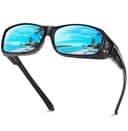
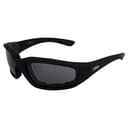
The word is used for two different things and only one of them is useful. A genuine wrap curves back around your face so the lens continues past the outer corner of your eye and the temple meets your head close in, leaving no open channel from the side. A cosmetic wrap is a curved lens on a frame that sits an inch off your face — it looks sporty and covers nothing.
The test takes five seconds in a mirror. Put the frame on, look straight ahead, and check whether you can see daylight in the gap between the outer edge of the lens and your cheekbone. If you can, so can the sun. Then look up: a gap above the lens is the same failure at the brow, and it is the one most frames have.
2. Base curve: the number that decides how much wrap is too much
Lens curvature is described by base curve, and sunglasses run from around a 4 base (nearly flat, the classic Wayfarer shape) to an 8 or 9 base (a full sport wrap). More curve means more coverage. It also means the lens is no longer perpendicular to your line of sight at its edges, which introduces distortion and, in prescription lenses, a genuine optical headache for whoever has to glaze them.
In practice: an 8-base wrap is fine for running, cycling and the water, where you are mostly looking straight ahead and movement masks small edge effects. It is less comfortable for reading a dashboard, a phone or a book, where your eyes track sideways across the lens. If you want the geometry in full, our base curve and wrap guide covers how much curve a lens can carry and why a wrapped prescription lens is a specialist job.
3. Three different reasons to buy one, and they want different frames
- Coverage against UV and low sun. You want lens height as much as width — a tall lens that reaches your brow, and temples that sit close. This is the AAO’s case, and the one that matters over a lifetime rather than an afternoon.
- Wind off the eye. You want a seal rather than coverage: a frame that meets your face, ideally with a foam gasket. Our dry eyes roundup ranks frames on exactly this, and it is a different ranking from this page.
- Retention during movement. You want grip and light weight: rubber nose pads, grippy temple tips, a frame that does not have far to fall. A heavy wrap that slides is worse than a light flat frame that stays put.
4. Polarized or not — and why one pick here deliberately is not
Polarization removes reflected glare, which is the AAO’s stated use case for it, and on water or a wet road it is transformative. Four of the six picks here have it.
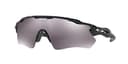
The exception is deliberate and it is the top pick. Oakley’s Prizm Road lens on the Radar EV is not polarized, and for the runner or cyclist it is aimed at, that is the right call rather than a shortcoming: a polarizing filter can flatten the visual cue you use to spot a wet patch or a slick manhole cover, which is information you want at speed. Golfers have the same objection for reading greens. So do pilots, per the FAA. If your reason for wearing a wrap is the road surface rather than glare off water, non-polarized is a legitimate choice — and we would rather explain that than quietly mark every pick as polarized. Our polarized vs non-polarized guide has the whole argument.
5. Fit, and the two body facts that decide it
A wrap is less forgiving of face size than a flat frame, because it is trying to follow the curve of your head rather than just sit in front of it.
- Too narrow and the frame pulls away from your temples under tension, opening the exact gap you bought it to close, and it grips painfully within an hour. If standard frames pinch, start at our wide-fit roundup.
- Too wide and it sits away from your cheeks, slides, and the wrap does nothing at all. Our small-face roundup covers the other end of the range.
- Bridge height matters more on a wrap than on a flat frame, because a frame sitting low leaves a wide brow gap. If frames slide down or leave marks, our low nose bridge guide is the place to start.
- Numbers beat guessing. The three figures printed inside the temple of a frame you already own tell you what fits; our size guide explains how to read them.
6. The fogging trade-off
Everything that makes a wrap good at blocking air makes it worse at clearing humidity. A sealed frame fogs when you stop moving, on a climb, in the cold, or when you come inside. Vents in the lens or frame, an anti-fog treatment, and a removable foam gasket are the three answers, and the third is the most flexible: run it sealed when it is windy and open when it is not. Our mountain biking roundup covers this in the sport where it bites hardest, because climbing pace plus a hot day is the exact fogging worst case.
7. Where wraps genuinely do not belong
They are not a universal answer. A deep sport wrap reads as athletic equipment with anything smart, which is a real consideration if you want one pair for everything — our everyday hub covers the shapes that go both ways. The curve can make a prescription lens expensive or impossible, depending on the correction; see our prescription sunglasses guide. And if you spend your day looking sideways across the lens — at screens, a bench, a book — a flatter frame is more comfortable to look through, even though it protects less.
What we left out, and why
Shield frames with no stated UV rating. The single-lens shield is the most complete form of wrap there is, and the fashion end of that category is full of frames that publish nothing about ultraviolet. A stated rating is this site’s minimum bar. That cost us at least one otherwise good large-fit shield.
Goggles. Better coverage than any sunglass and a different product. For snow, our ski and snow roundup covers when goggles are the right call instead.
Cosmetic “wrap” frames. A curved lens on a frame that stands off your face fails the mirror test above. Several are perfectly good sunglasses — they are just not on this page, because coverage is what this page is about.
Where to spend and where not to
Spend on fit and lens height. A wrap that matches your face width seals the sides, and a tall lens closes the brow gap that most frames leave open — those two things are the entire reason to buy this shape, and both are free to get right if you measure first.
Do not spend up for ultraviolet protection, which does not scale with price: the AAO states plainly that price is not a proxy for protection, and a twenty-dollar wrap marked UV400 filters the same ultraviolet as a premium one. What the premium picks here genuinely add is optical quality across a curved lens — which is harder to manufacture than a flat one and is where cheap wraps most often disappoint — plus coatings and a frame that keeps its shape. If the wrap is for a specific sport, our sport hub will point you at the roundup for it.