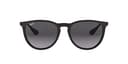
How to choose sunglasses for a diamond face
1. Put the visual weight at the top of the frame
This is the whole strategy. Your forehead is the narrowest of the three widths, so a frame that has presence along its upper edge — a browline, a thicker top rail, an upswept outer corner — adds apparent width exactly where the face wants it and brings the top of your face closer to your cheekbone width.
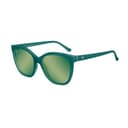
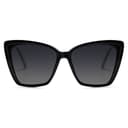
A cat-eye does this better than any other shape, which is why it leads this list. The upswept outer corners draw the eye up and out, widening the brow line visually while the lower edge of the lens curves in and away from the cheekbone. Our cat-eye roundup covers the shape in full, including the lens-spec problem the category has.
2. Soften the cheekbone, do not emphasize it
The second half of the rule. A frame whose widest point sits at your cheekbone adds width to the widest part of your face, exaggerating the taper above and below it. That is the error to avoid, and it is what makes a large squared frame look wrong on this shape even when it is technically the correct size.
Curves work here in a way they do not on rounder faces. An oval or gently rounded lens follows the line of the cheekbone rather than cutting across it, so the eye reads a smooth outline rather than a horizontal shelf. Our round frames roundup has more of this shape.
3. Rimless and semi-rimless are genuinely useful here
An underused option on this shape. Removing the lower rim removes the horizontal line across your cheekbone entirely, so the frame contributes width only at the top. Thin metal frames achieve much of the same effect — they read as a light sketch of a shape rather than a solid block.
The trade is coverage. A thin or rimless frame is a small frame, and a small frame lets more light in around the edges. The AAO recommends wraparound styles where sun exposure is the main event, so save the delicate frames for town and keep something wrapped for the beach or the water. Our base curve and wrap guide covers the coverage question.
4. Get the width right, because this shape is fussy about it
The standard fit rule — the frame should be as wide as the widest part of your face — needs care on a diamond face, because the widest part is your cheekbone and a frame that wide will sit on it.
What works better: match the frame width to your cheekbone width, but choose a shape whose widest point sits above the cheekbone. A cat-eye is widest at its upper outer corners, which is exactly the right geometry. Our size guide explains how to read the three numbers printed inside a temple arm and use them to buy without trying a frame on.
5. Watch the bridge, because a narrow nose bridge often comes with this shape
Not universal, but common enough to check. A diamond face frequently comes with a narrow or low nose bridge, and a frame whose bridge is too wide will slide down no matter how well the rest of it fits — and will then rest on your cheekbones, which is uncomfortable and looks wrong.
Adjustable nose pads solve it, which is a quiet argument for a metal frame. Our low nose bridge guide covers the fitting problem properly, and why sunglasses slide down covers the mechanics.
The two shapes to be careful with
- Large squared and rectangular frames. These put a strong horizontal line across the widest part of your face and add width where you have most of it. If you love the look, go smaller than you think and choose a version with softened corners. Our rectangular roundup notes which frames are softened.
- Narrow, small frames with no top presence. The opposite failure. A small frame with a thin top rail contributes nothing at the brow, leaving the taper unaddressed and the cheekbones dominant.
Aviators sit in between. The teardrop is widest at the top, which is the right geometry, but the classic aviator runs large and its lower point can reach the cheekbone. A smaller lens width works; the oversized version generally does not. Our aviator roundup covers the sizing.
Fit rules are a starting point, not a law
Worth saying plainly, because face-shape advice is often written as though it were optometry. It is not. These are conventions about visual balance, and the AAO’s own guidance on choosing sunglasses leads with the specifications that affect your eyes — ultraviolet filtering, coverage, lens quality — not with your jawline.
So use the rule to narrow a shortlist, then buy the pair you will actually wear. A frame you like that breaks the rule beats a technically correct frame that stays in a drawer, because the pair in the drawer is filtering no ultraviolet at all.
Where to spend and where not to
Spend on a frame with adjustable nose pads if your bridge is narrow, because that is the fit variable most likely to ruin an otherwise good frame on this face shape. Spend on polarization if you drive or spend time near water — see our polarized vs non-polarized comparison.
Do not spend a premium on a cat-eye for the shape alone. It is a style-led category where many frames are not polarized and some do not publish a UV figure at all, so a $20 pair that states UV400 is a better buy than a $200 pair that states nothing. Our UV protection guide explains what to insist on, and the fit hub has the guides for the other five face shapes.