Shade & Temple

Best Sunglasses for Kids

Children get more UV exposure than adults and far worse eyewear. Six picks judged on the one thing most kids' listings do not publish — a UV rating.

By Stephen V.Last updated How we pick

There is an uncomfortable asymmetry in children’s eyewear. The American Academy of Ophthalmology notes that children are at the highest risk of eye damage in bright sunlight — they spend more hours outdoors than most adults, and UV damage to the eye is cumulative over a lifetime, so exposure in childhood matters disproportionately. Yet the children’s sunglasses market is dominated by novelty frames whose listings publish nothing at all about ultraviolet.

That is the specific failure this page is built around. A dark lens with no UV filter is worse for a child than no sunglasses at all, because the darkness opens the pupil and lets more ultraviolet reach the back of the eye. The AAO’s guidance is to look for a sticker or tag promising 100% UV protection, and for younger children to look for eyewear meeting the ANSI Z80.3 safety standard, which covers both UV and impact.

So we have led every pick with what its listing actually publishes, and flagged plainly where a UV figure is missing — because on several otherwise good children’s frames it is. The six picks cover toddlers through youth sport, from $10 to $30. Prices are pulled live and dated.

How this is funded: we earn a commission if you buy through our links, at no extra cost to you. It never changes which product we recommend, and we’ll tell you when we’d skip one. Full disclosure.

Quick picks

Ranked on lens spec, UV protection, tint fit and buyer value. Select a row to jump to the full write-up. We have not field-tested these — here is exactly what we do instead.

#ProductBest forPrice
1

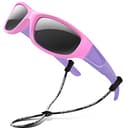
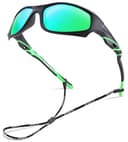
RIVBOS RBK037 Kids Polarized

The one to buy on spec: polarized AND a stated UV400 rating AND a retaining strap, for under ten dollars. The strap is the feature parents underrate — it turns the pair from something a toddler removes and drops into something that hangs on their chest.

Best overall on spec
2
Babiators Original Navigator

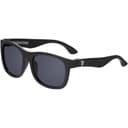
Babiators Original Navigator

The kids' brand that solved the real problem, which is not lens quality but attrition — Babiators sells its frames with a published lost-and-broken replacement policy, because a three-year-old will throw a pair out of a pram. Flexible rubber frame, stated UV protection, and sized properly by age band rather than sold as one-size.

Best for toddlers
$29.99 · View on Amazon

Price as of September 4, 2026. #ad How we’re funded

3
NULOOQ Kids Flexible Polarized

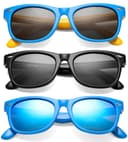
NULOOQ Kids Flexible Polarized

Polarized lenses on a flexible toddler frame for around fourteen dollars, which is the sweet spot for this category — cheap enough that losing them is survivable, but with a lens spec that is not just a dark plastic filter. Sized for ages 3-8, and the frame twists rather than breaking.

Best everyday value
$13.29 · View on Amazon

Price as of September 4, 2026. #ad How we’re funded

4
Pro Acme TR90 Kids Polarized Sports

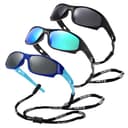
Pro Acme TR90 Kids Polarized Sports

A TR90 sport frame scaled down for children, sold as a three-pack with straps for ages 3-12. TR90 is the same nylon family the adult sport brands use — it is why these bend hard and come back rather than cracking — and a three-pack is a realistic response to how often a child's sunglasses disappear.

Best for active kids
$15.62 · View on Amazon

$16.988% off

Price as of September 4, 2026. #ad How we’re funded

5
NULOOQ Kids Baseball Polarized

NULOOQ Kids Baseball Polarized

A youth sport wrap for ten dollars, sized for ages 4-12 and shaped to sit under a cap brim — which is the specific thing a scaled-down lifestyle frame gets wrong. Polarized, and priced so that a season of little league does not become an equipment budget line.

Best for youth sport
$9.99 · View on Amazon

$11.9917% off

Price as of September 4, 2026. #ad How we’re funded

6
goodr OG

goodr OG

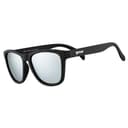
The best $25–35 in sunglasses. The OG is genuinely polarized, UV400, and its rubberized grip coating means it doesn't bounce or slide on a run — the reason it became runners' cult favorite. A squared retro shape that flatters round faces, in dozens of colorways. The value pick, full stop.

Best for teens
$30.00 · View on Amazon

Price as of September 4, 2026. #ad How we’re funded

The picks in full

#1Best overall on spec

RIVBOS RBK037 Kids Polarized

The one to buy on spec: polarized AND a stated UV400 rating AND a retaining strap, for under ten dollars. The strap is the feature parents underrate — it turns the pair from something a toddler removes and drops into something that hangs on their chest.

Strengths

  • Polarized and UV400 both stated — the only kids' pick here with both
  • Retaining strap included, so the pair stays with the child
  • TPE frame flexes rather than snapping

Trade-offs

  • Under-ten-dollar hinges and coatings; expect a season
  • The strap is a strangulation consideration for the very youngest — supervise, and remove it for under-3s
Lens featurePolarized, UV400, TPE frame with strap
PolarizedYes
Lens tintNot published
Frame materialTPE (flexible)
UV protectionUV400
Best forToddlers, Young children, Beach, Everyday

Spec note. The listing states polarized UV400 lenses on a TPE frame supplied with a retaining strap, for boys and girls (RBK037).

Specs read from the product listing, on August 11, 2026. “Not published” means the brand does not state that figure.

#2Best for toddlers

Babiators Original Navigator

The kids' brand that solved the real problem, which is not lens quality but attrition — Babiators sells its frames with a published lost-and-broken replacement policy, because a three-year-old will throw a pair out of a pram. Flexible rubber frame, stated UV protection, and sized properly by age band rather than sold as one-size.

Strengths

  • Flexible rubber frame bends rather than snapping when it is sat on
  • Sized by age band (3-5 and 6-10) instead of a single one-size frame
  • Stated UV protection — which a lot of children's sunglasses do not publish

Trade-offs

  • The most expensive kids' pair here by a wide margin
  • Not polarized, so no glare control on water or snow
Lens featureFlexible rubber frame, UV protection, age-banded sizing
PolarizedNot published
Lens tintBlack
Frame materialFlexible rubber
UV protectionUV protection stated (rating not published)
Best forToddlers, Young children, Everyday

Spec note. The listing states UV protection on a flexible kids' frame sized for ages 3-5, in the Original Navigator shape. A specific UV400 or percentage figure is not published.

Specs read from the product listing, on August 11, 2026. “Not published” means the brand does not state that figure.

#3Best everyday value

NULOOQ Kids Flexible Polarized

Polarized lenses on a flexible toddler frame for around fourteen dollars, which is the sweet spot for this category — cheap enough that losing them is survivable, but with a lens spec that is not just a dark plastic filter. Sized for ages 3-8, and the frame twists rather than breaking.

Strengths

  • Polarized, which most children's sunglasses at this price are not
  • Flexible frame twists back into shape after being sat on
  • Cheap enough to buy two and keep a spare in the car

Trade-offs

  • No published UV rating despite the polarization claim
  • The 3-8 band is wide — check the measurements against your child's face
Lens featurePolarized flexible kids' frame
PolarizedYes
Lens tintNot published
Frame materialFlexible (bendable)
UV protectionNot published
Best forToddlers, Young children, Everyday

Spec note. The listing states polarized lenses on a flexible kids' frame for ages 3-8. A UV rating is not published for this SKU.

Specs read from the product listing, on August 11, 2026. “Not published” means the brand does not state that figure.

#4Best for active kids

Pro Acme TR90 Kids Polarized Sports

A TR90 sport frame scaled down for children, sold as a three-pack with straps for ages 3-12. TR90 is the same nylon family the adult sport brands use — it is why these bend hard and come back rather than cracking — and a three-pack is a realistic response to how often a child's sunglasses disappear.

Strengths

  • TR90 nylon frame — the same material family as adult sport frames, and near-unbreakable
  • Polarized, with straps included
  • Three pairs in the pack covers the loss rate

Trade-offs

  • No published UV rating alongside the polarization claim
  • Sport styling, so it will not suit a child who wants a lifestyle shape
Lens featureTR90 frame, polarized, three-pack with straps
PolarizedYes
Lens tintVaries by pack (mirrored and plain)
Frame materialTR90
UV protectionNot published
Best forChildren's sport, Ages 3-12, Everyday

Spec note. The listing states unbreakable TR90 polarized kids' sunglasses supplied with straps for ages 3-12, sold as a multi-pack. A UV rating is not published.

Specs read from the product listing, on August 11, 2026. “Not published” means the brand does not state that figure.

#5Best for youth sport

NULOOQ Kids Baseball Polarized

A youth sport wrap for ten dollars, sized for ages 4-12 and shaped to sit under a cap brim — which is the specific thing a scaled-down lifestyle frame gets wrong. Polarized, and priced so that a season of little league does not become an equipment budget line.

Strengths

  • Wrap shape sits under a cap brim, unlike a shrunken lifestyle frame
  • Polarized at ten dollars
  • Sized for the 4-12 band rather than sold as one-size

Trade-offs

  • No published UV rating — an important omission on a sport pair worn for hours
  • Basic frame with no impact certification; it is a sun frame, not eye protection
Lens featurePolarized youth sport wrap
PolarizedYes
Lens tintNot published
Frame materialNot published
UV protectionNot published
Best forYouth baseball, Children's sport, Ages 4-12

Spec note. The listing states polarized youth baseball sunglasses for boys and girls aged 4-12. A UV rating is not published for this SKU.

Specs read from the product listing, on August 11, 2026. “Not published” means the brand does not state that figure.

#6Best for teens

goodr OG

The best $25–35 in sunglasses. The OG is genuinely polarized, UV400, and its rubberized grip coating means it doesn't bounce or slide on a run — the reason it became runners' cult favorite. A squared retro shape that flatters round faces, in dozens of colorways. The value pick, full stop.

Strengths

  • Genuinely polarized and UV400 at a sub-$35 price
  • No-slip, no-bounce grip coating stays put on a run
  • Squared retro shape flatters round faces; dozens of colors

Trade-offs

  • One size — a narrow face may find the OG a touch wide
  • Plastic frame and standard lens won't match a glass premium lens for clarity
Lens featurePolarized, UV400, no-slip grip
PolarizedYes
Lens tintVaries by colorway
Frame materialPolycarbonate (plastic)
UV protectionUV400
Best forRunning, Everyday, Round faces

Spec note. goodr lists the OG as polarized with UV400 protection and a no-slip coating; colorways change but the lens spec is consistent.

Specs read from the product listing, on July 18, 2026. “Not published” means the brand does not state that figure.

How to choose children’s sunglasses

1. Insist on a published UV figure — most listings do not have one

This is the whole exercise. You are looking for one of three phrasings, all of which the AAO accepts: 100% UV protection, UV400, or UV absorption up to 400nm. Prevent Blindness gives the same advice for adults — buy only sunglasses that carry a clear statement of UV blocking.

If a listing describes the colors, the flexibility and the strap and never mentions ultraviolet, treat the pair as unprotected. There is no home test for UV, because it is invisible; our guide to whether polarized lenses block UV explains why, and why a polarization claim does not stand in for a UV one.

2. For younger children, look for ANSI Z80.3

The AAO specifically recommends that sunglasses for young children be rated to ANSI Z80.3, which is the American National Standard for non-prescription sunglasses and fashion eyewear. It covers both UV transmittance and impact performance — the second matters because a small child will fall over wearing them.

Not many marketplace listings state it, which is a reasonable reason to prefer a brand that does. The FDA regulates sunglasses as medical devices in the US and its guidance points to the same standard family.

3. Buy a frame that bends, not one that breaks

The physical reality of children’s eyewear is that it gets sat on, stood on, thrown and slept on. Two materials handle that: flexible rubber or TPE, which twists and returns to shape, and TR-90 nylon, which is what adult sport frames are made from and is close to unbreakable at this scale.

Rigid molded plastic snaps at the hinge, usually within two weeks. Metal frames bend permanently and leave a sharp end.

4. Size by age band, and check it

A shrunken adult frame is not a children’s frame. It will sit past the temples, lift off the nose and slide, which means it gets pushed up onto the head and stops protecting anything. Look for eyewear sold with a stated age band — 0-2, 3-5, 6-10, 4-12 — and check the millimeter measurements if they are published.

Our size guide explains how to read those numbers and how to measure a pair that already fits, which is the fastest route to a second pair that also does.

5. Straps: useful, with an age caveat

A retaining strap turns sunglasses from something a child removes and drops into something that hangs on their chest, and it is the single feature most responsible for a pair surviving a holiday.

The caveat is honest and worth stating: any cord around a very young child’s neck is a supervision matter, and for under-3s the sensible approach is to remove the strap or use a frame designed to stay on without one. For older children it is straightforwardly a good idea.

6. Coverage matters more on a small face

Both the AAO and the CDC recommend wraparound or larger frames because they block light arriving from the side, and on a child that advice is doing more work than usual — a small lens shades very little of the surrounding skin. Pair sunglasses with a brimmed hat, which the AAO recommends alongside eyewear for exactly this reason.

Why children need this more than adults do

Three reasons that compound. First, exposure: children spend substantially more time outdoors than most adults, and much of it in the middle of the day. Second, cumulative damage: the AAO links UV exposure to raised risk of cataract, growths on the eye and eye cancer, and the exposure adds up over a lifetime, so childhood years count more than later ones. The World Health Organization estimates that a meaningful share of cataracts worldwide may be attributable to UV exposure.

Third, and most often missed: a child’s eye is more transmissive than an adult’s. The lens inside the eye yellows gradually with age, and that yellowing filters some ultraviolet — so a young child’s eye passes more UV through to the retina than an adult’s does.

None of that requires expensive eyewear. It requires eyewear that states a UV figure, worn reasonably often. Our UV protection guide covers what the labels mean.

Sunglasses are not sport eye protection

Worth being explicit, because parents buying for youth sport frequently conflate the two. Prevent Blindness states that ordinary sunglasses — and even occupational safety glasses — do not provide adequate protection against ball impact, and that what does is a sport eye guard meeting the relevant ASTM standard for the sport, with polycarbonate lenses.

So the youth sport pick on this list is a sun frame, not eye protection. If your child plays baseball, softball, or a racket sport, buy proper eye guards separately. Our baseball roundup makes the same distinction from the adult side.

Getting a child to actually wear them

The practical half of the problem, and it decides whether any of the above matters.

  • Fit first. Anything that pinches behind the ears or slides down comes off within ten minutes and stays off. This is the main cause of rejection.
  • Let them choose the color. The spec decision is yours; the colorway genuinely is not worth fighting over.
  • Wear yours. Modeling works better than instruction with eyewear, as with most things.
  • Keep a spare. Buying a two- or three-pack is not indulgence, it is planning. A lost pair should not mean an unprotected week.

Where to spend and where not to

Do not spend much. The specification that matters costs almost nothing, and the attrition rate in children’s eyewear is brutal — a $10 pair that gets replaced twice a summer is a better plan than a $40 pair that gets lost in week two and not replaced.

The one case for spending more is a brand with a published replacement policy for lost and broken pairs, which changes the arithmetic for toddlers specifically. Beyond that, apply the same rule as for adults: our honest answer on expensive sunglasses applies equally to children, and our under-$50 roundup covers the adult end of the same logic. For teens moving into adult sizing, our small-face roundup is usually the right next page.

Frequently asked questions

Do kids really need sunglasses?

Yes, and arguably more than adults. The American Academy of Ophthalmology notes that children are at highest risk of eye damage in bright sunlight — they spend more time outdoors, UV damage is cumulative over a lifetime so early exposure counts more, and a young child's eye lens is more transmissive to ultraviolet than an adult's because it has not yellowed with age.

What UV rating should children's sunglasses have?

Look for 100% UV protection, UV400, or 'UV absorption up to 400nm' — the AAO accepts all three phrasings. For younger children the AAO additionally recommends eyewear rated to ANSI Z80.3, the American National Standard for non-prescription sunglasses, which covers both UV transmittance and impact performance. If a listing does not state a UV figure at all, treat the pair as unprotected.

Should kids' sunglasses be polarized?

It is a nice extra rather than a requirement. Polarization cuts reflected glare off water, sand and wet surfaces, which makes a beach or pool day more comfortable, but it is not connected to eye health. UV protection is the specification that matters. Where you can have both at the same price — and several children's pairs do — take both.

At what age can a child wear sunglasses?

As soon as they will tolerate them, which for many children is from toddlerhood. The AAO advises that babies and children need hats and sunglasses because UV can harm the eyes and raise the risk of cataract and growths later in life. For infants, a wide-brimmed hat and shade are the practical first line, with sunglasses added when the child will keep them on.

Are kids' sunglasses with straps safe?

For older children, yes, and the strap is the single feature most responsible for a pair surviving. For very young children, any cord around the neck is a supervision matter — the sensible approach for under-3s is to remove the strap or choose a wraparound frame designed to stay on without one. Never leave a strapped pair on a sleeping child.

Do kids' sunglasses protect against sports injuries?

No. Prevent Blindness is explicit that ordinary sunglasses — and even occupational safety glasses — do not provide adequate protection against ball impact, and that what does is a sport eye guard meeting the relevant ASTM standard for that sport. Buy sunglasses for the sun and proper eye guards for impact; they are separate purchases with separate jobs.

Sources

Keep reading