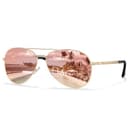
Why the FAA advises against polarized lenses
Three distinct reasons, all specific to a cockpit, and all worth understanding rather than taking on trust.
- Instrument anti-glare filters. Many cockpit instruments incorporate anti-glare treatments that work by polarizing light. A polarizing filter in front of your eye can cancel those, reducing or eliminating the visibility of the instrument entirely at certain head angles. Losing an instrument reading because you turned your head is not an acceptable failure mode.
- Windshield striations. Aircraft windshields are laminated, and lamination produces internal stress patterns. Ordinarily invisible, a polarizing filter makes those striations visible as a rainbow or banded pattern across the screen, which degrades your view through the one surface you most need to see through.
- The glint you need to see.This is the subtlest and arguably the most important. Polarization removes light reflected off shiny surfaces — and the flash of sun off another aircraft’s wing or windshield is exactly how you acquire traffic visually at distance. Removing it can reduce the time a pilot has to react.
Note that reason three has no equivalent on the ground. Everywhere else, removing reflected light is the whole benefit — our polarized vs non-polarized comparison covers the normal case. In the air, some of that reflected light is traffic information.
Why photochromics are also out
The FAA advises against these as well, for reasons that are practical rather than safety- critical, and that are worth knowing for anyone considering a photochromic lens generally.
- They barely darken in a cockpit.Photochromic lenses are triggered by ultraviolet, and aircraft glass blocks much of it — the same reason they fail behind a car windshield. Reduced UV exposure in a cockpit further limits their effectiveness.
- Heat defeats them.The FAA notes that warm temperatures above roughly 70°F seriously limit a photochromic lens’s ability to darken. A cockpit in the sun is warm.
- They are slow, and may not clear fully. Most of the darkening happens quickly but lightening can take several minutes, and the faded state of some photochromic lenses may not be clear enough for the task.
Our photochromic guide covers these limits in general, and our photochromic vs polarized comparison covers choosing between them when you are not flying.
What the FAA does recommend
Neutral gray, 15–30% light transmittance
The brochure’s summary recommendation is a neutral gray tint with 15 to 30% light transmittance. Gray because it distorts color least, which matters when navigation lights, signals, color-coded maps and instrument displays all carry information in their color. Gray-green and brown are also listed as acceptable choices, with the note that some pilots find they enhance contrast in haze.
15–30% transmittance corresponds to filter category 2 and the lighter end of category 3 — not the darkest lens available, deliberately. The FAA warns against tints blocking more than about 85% of visible light because of the possibility of reduced visual acuity and difficulty reading material inside the cockpit. Our lens categories guide explains the scale.
Not yellow, amber or orange
Explicitly cautioned against. These tints eliminate short-wavelength light, and while that can lift apparent contrast, the FAA notes they make it difficult to distinguish the color of navigation lights, signals, color-coded maps and instrument displays.
That is the same objection we make to yellow lenses sold for night driving, arrived at independently. Where amber genuinely earns its place is shooting in flat overcast light, where there is nothing color-coded to misread.
100% UV, and altitude makes it matter more
The brochure cites the American Optometric Association’s recommendation of 99–100% UVA and UVB protection, and notes something that applies to mountains as much as aircraft: UV exposure increases by approximately 5% for every 1,000 feet of altitude.
At 10,000 feet that is roughly half again as much ultraviolet as at sea level. This is the one specification to refuse to compromise on. Our UV protection guide covers the labels, and our UV testing guide covers verifying a pair.
A frame that works with a headset
The FAA is direct that an aviator’s frames must be functional and must not interfere with communication headsets or protective breathing equipment. A thick temple arm breaks the seal of a headset’s ear cup, which costs you noise attenuation and comfort on a long leg.
Thin, flat temples are the answer — which is a large part of why the classic metal aviator became the pilot’s frame in the first place. It is a genuine functional property, not just heritage. The same logic applies on a shooting range with ear defenders.
Not too small
One more from the brochure, and it applies well beyond aviation: frame styles with small lenses may not be practical, since they allow too much visible light and UV radiation to pass around the edges of the frame.
That is an argument for a reasonably large lens, which is the other reason the aviator shape suits the job. Our aviator roundup covers the shape more broadly, and our base curve and wrap guide covers coverage geometry.
A strap, and lens material
The brochure recommends a strap or chain to prevent prescription sunglasses being dislodged by turbulence or manoeuvring. On lens material it sets out the trade cleanly: crown glass and CR-39 plastic have superior optical qualities, while polycarbonate is lighter and the most impact-resistant available, with UV protection built into the material rather than applied as a coating. Our glass vs polycarbonate comparison covers the same ground for ground-level use.
Why the picks look the way they do
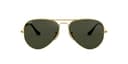
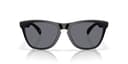
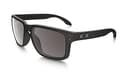
Everything above narrows the field sharply, and it explains a list that would look wrong on any other page. Three of the five picks are frames we describe elsewhere as compromised precisely because they are not polarized — the standard Ray-Ban Aviator with its non-polarized G-15 lens, the plain gray Oakley Frogskins, the warm gray Holbrook.
In a cockpit that is the correct specification rather than a shortcoming. All three state 100% UV filtering, all three are neutral or near-neutral tints, and the two Oakleys use Plutonite, which filters 100% of UVA, UVB and UVC to 400nm regardless of tint.
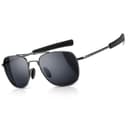
The budget aviators are on the list for the flight-bag case. A spare pair costs very little and squinting is worse than an inexpensive lens — but check the SKU, because many budget aviators are polarized by default, which is the one thing you do not want here.
A note on what this page is and is not
This is a buying guide that follows published FAA guidance for pilots. It is not operational advice, it does not substitute for your own training, your aircraft’s documentation or your aviation medical examiner, and eyewear requirements can differ for commercial operations. The FAA brochure itself notes that lens technology continues to evolve and recommends discussing current options with an eyecare practitioner.
Where to spend and where not to
Spend on optical quality and on a frame that genuinely works with your headset, because those are the two things you will notice on every flight. Spend on a strap.
Do not spend on polarization — here, uniquely, you are paying for something you should not want. Do not spend on a very dark lens, since the guidance caps at around 85% light blocking. And do not buy an amber or yellow “contrast” lens for a cockpit whatever it is marketed as doing. For flying, keep a separate pair from the polarized one you drive in — our driving roundup covers that pair, and the everyday hub has the rest.