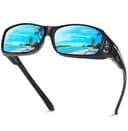
What a bifocal sunglass actually is
A tinted lens with a second, stronger optical zone ground into the bottom of it. Look straight ahead and you are looking through the tinted distance portion; drop your eyes and you are looking through a magnifier. In most of what is sold on this basis the magnifier is a visible half-moon segment near the bottom edge, exactly as in a traditional bifocal spectacle; some newer frames blend the transition so it is less obvious.
The distance portion is not a prescription. It has no correction in it at all — it is plain tinted lens. That is what separates this product from prescription sunglasses, where an optician grinds your actual script into the lens. A bifocal sunglass is for someone whose distance vision is fine and whose near vision has gone soft with age, which is most people past their mid-forties. If you need correction at distance as well, none of the picks on this page will help and the prescription route is the one you want.
It is worth knowing that regulators treat the magnifier as its own thing. The FDA’s device page for this corner of the market is titled “Sunglasses, Spectacle Frames, Spectacle Lens and Magnifying Spectacles” and points at the ANSI Z80.3 and ISO 8980-3 standards for UV and light transmittance. A reputable listing will reference meeting a standard; one of our picks does, and it is the one we rank first.
How to choose bifocal sunglasses
1. A stated UV rating, first and non-negotiable
This is the criterion that eliminated most of the category. Sun readers are sold on the strength of the magnifier, and a surprising number of listings never mention ultraviolet at all. A tinted lens with no UV filter is actively worse than no sunglasses: the tint opens your pupil and then passes UV through the larger aperture. The AAO’s guidance is to look for 100% UV or UV400 and to ignore darkness and price as proxies for it.
All five picks below state a UV figure. Several frames that were cheaper, in stock and otherwise appealing are not here because they did not — including a polarized bifocal aviator that was the most attractive-looking thing we checked. Our page on UV protection and what UV400 means covers why the number is a hard floor rather than a nice-to-have, and how to test a pair you already own is the honest answer to “can I check?”
2. Your reading power, which is the thing people get wrong
Bifocal sunglasses are sold by diopter — +1.00, +1.50, +2.00, +2.50, +3.00 — and many of the sport frames are sold in only two or three of them. Buying the wrong power is the single most common reason one of these ends up in a drawer. Three ways to get it right, in descending order of reliability.
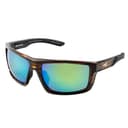
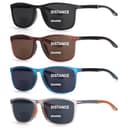
If you already wear readers, read the number off the inside of the temple arm and buy the same. This is by far the easiest route and it is why we rank the Waccamaw first: it comes in x1.5, x2.0 and x2.5, so most existing reader owners will find their number. If you do not own readers yet, buy a cheap multipack in one power, try it on the things you actually need to see, and treat the fifteen dollars as the cost of finding out — which is the entire reason the four-packis on this page. And if your near vision has changed noticeably in the last year, or one eye is clearly worse than the other, that is a reason to get an eye exam rather than a reason to buy a stronger pair. The National Eye Institute’s position is that regular comprehensive dilated eye exams help adults aged 50 and over catch eye disease early; the AAO recommends a complete exam every one to two years after 65. Over-the-counter magnifiers are a convenience product, not a diagnosis.
A practical note on going too strong. A higher power gives you a shorter working distance, not better vision — a +3.00 brings the focal point in close enough that a phone held at arm’s length is blurred again. If you are choosing between two, the weaker one is usually the right buy.
3. Polarization, which most of them do not have
This is where sun readers quietly differ from sunglasses. The AAO identifies polarization as the feature that addresses reflected daytime glare — off water, wet roads, car hoods, polished floors — and it is the single most useful lens feature for the two activities that dominate this category’s search demand, which are fishing and driving. And yet half of what is sold as a bifocal sunglass makes no polarization claim whatsoever.
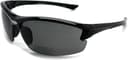
Two of our picks state it — the Waccamaw and the Renegade — and two do not, and their cards say “Not published” rather than quietly implying it. If you are buying these to tie knots on the water or to read a chart in a boat, pay for the polarized pair; the difference is not subtle. If you are buying them to read a book in the garden, it genuinely does not matter. Our polarized lens guide covers the mechanism, and how to tell whether a pair is polarized is the test to run on a pair that arrives without a label.
There is one honest trade against polarization here, and it is specific to bifocals: a polarizing filter can dim or blank an LCD at some angles. If the close-up thing you most need to see is a phone screen, a dash display or a glucose meter, check it with the glasses on before you commit.
4. Where the segment sits, and the blurred-feet problem
Every bifocal has the same drawback and no design removes it: the bottom of your field of view is magnified, so looking down at your own feet is blurred and closer than it looks. On a flat lawn that is nothing. On a dock, a boat ramp, a staircase or rough ground it is a genuine trip risk, and the correct habit is to take them off to walk rather than to get used to it.
Frame shape changes how much it intrudes. A half-rim frame — which is what the Renegadeis — leaves the bottom lens edge open, so when you drop your eyes past the reading segment there is less frame in the way; it is the quietly sensible shape for this product and it is why anglers gravitate to it. A full wrap like the Waccamaw gives you much better side coverage, which is what you want for a day in the sun, at the cost of a slightly more enclosed feel at the bottom of the lens. Neither is wrong. Our sizing guide covers how to read frame measurements, which matters here because a reading segment placed for an average face sits in the wrong place on a small one.
5. The four alternatives, two of which are cheaper
A buyer-first page has to say when the product is the wrong answer, and for this one there are four competing routes.
A fit-over, worn over your own readers.The cheapest good option if you already own readers you like. You keep the exact magnification you are used to and add a polarized, UV400 tinted shell over the top — which is why the Duco fit-over is the fifth pick here rather than a sixth bifocal. The catch is bulk and the need to measure your existing frame first; our fit-over guide covers both.
A clip-on over your readers. Lighter and less obvious than a fit-over, and the AAO notes the replacement-cost argument in favor of clip-ons over a second prescription pair. The limitation is that a clip-on gives you no side coverage at all, so it is a city-and-commute answer rather than a day-on-the-water one. See our clip-on roundup.
Prescription progressive sunglasses. The best result and the most expensive by a wide margin. The AAO notes that sunglasses can be made in nearly any prescription, including as bifocals for reading; the practical limits are frame curvature and lens thickness rather than the script itself. If you wear glasses full-time anyway, this is what you should be pricing.
Carrying both pairs. Unfashionable, free, and what a lot of people end up doing anyway. The reason bifocal sunglasses sell is that it is exactly what nobody wants to do while holding a fishing rod.
A note on the brand behind the top pick. KastKing is a tackle company rather than an eyewear company, which is why the Waccamaw states its lens material, its magnifier powers and its coating where most sun readers state none of the three. It is also why the line is inconsistent: two other KastKing models run different lens materials at half the thickness of each other. Our KastKing sunglasses reviewreads the brand’s own spec pages and sorts out which model is which.
Who each pick is for
On the water, tying knots. The Waccamaw if you want wrap coverage and the best-stated lens, or the Renegade if you prefer a half-rim and +2.00 is your number. Both state polarization, which on water is the whole point. Our fishing roundup covers the non-bifocal options for the same job.
Driving, with a map or a phone to check. Polarized, and test your dash display first. If polarization blanks a screen you rely on, go unpolarized and read our driving roundup for why that is a defensible choice rather than a compromise.
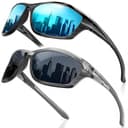
Gardening, reading, crosswords on a terrace. The two-pack or the four-pack. Polarization is not stated on either and you do not need it for this; UV400 is stated on both and that is the part that matters. Multipacks also solve the real problem, which is that readers are never in the room you are in.
Already wearing readers you like. The fit-over. Keep the magnification you are used to and add the tint. If your interest in this page started with glare and contrast rather than close focus, our roundup for older adults is probably the page you actually want, and sunglasses after cataract surgery covers the case where an operation has changed your near vision.
Most of this category is sold into fishing, so if you want the same reading segment framed for everyday wear, our picks for women over 50 set the bifocal options next to frames you would choose on looks.