The lens question, answered properly
UV protection: not the thing to worry about
Ray-Ban states that its lenses block 100% of UV rays across the range, and there is no reason to doubt it — this is a mainstream optical manufacturer selling into regulated markets. So on the one measure that is genuinely about your eye health, every Ray-Ban clears the bar the American Academy of Ophthalmology sets. That is also the reason UV should not be your deciding factor between a Ray-Ban and a $30 pair that states UV400: both are protecting you. Price buys you almost nothing here, and the AAO says so explicitly. Our UV400 guide unpacks the labeling.
Polarization: the thing to actually check
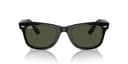
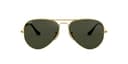
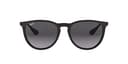
This is where money changes what you see. Polarization filters the horizontally oriented light that bounces off flat surfaces — water, wet tarmac, a car hood, a glass storefront — and removing it is the difference between squinting at a lake and seeing into it. The base G-15 Wayfarer does not do this. Nor does the standard Aviator, nor the standard Erika. Ray-Ban does sell polarized versions of all three; they cost meaningfully more and the listing will say so.
If you are choosing between a non-polarized Ray-Ban and a polarized budget pair for driving, boating or anything near water, the budget pair genuinely does the more useful job. That is not a fashionable thing to write on a page about a heritage brand, but it is true, and our polarized vs non-polarized comparison lays out exactly what you gain and lose. If you want to check a pair you already own, our one-minute polarization test will settle it.
G-15, gradients and glass
The G-15 crystal lens on the classic Wayfarer is genuinely good glass: it holds color close to neutral with a slight green cast, and glass resists scratches far better than polycarbonate. The trade is weight and impact safety — glass is heavier on the nose and does not belong in a sport frame. Gradient lenses, like the one on the Erika, are darker at the top and lighter at the bottom, which is a real convenience for driving and for looking down at a screen. Our glass vs polycarbonate guide covers that trade-off in full.
Which Ray-Ban fits which face
Ray-Ban’s real advantage is that its range covers all four face-shape cases with genuine classics, and the fitting rule is simple: contrast your face’s dominant geometry rather than echo it.
- Round or soft features — the angular Wayfarer adds the definition a round face lacks. It is the single most reliable frame recommendation we make, and it anchors our round-face roundup.
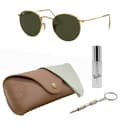
- Square or strong jaw — go the other way. The RB3447 Round Metal is a true circle and the most effective counterweight to an angular face; the teardrop Aviator is the softer, more wearable version of the same idea. Both feature in our square-face roundup.
- Narrow or small face — the 54mm Erika sits where a 58mm Aviator overhangs. Check the millimeter figure on the listing rather than the model name; our size guide explains how to read it.
- Wide face or large head — this is Ray-Ban’s weakest case. Large Aviator sizes help, but the acetate classics run narrow across the front, and you will generally be better served by the frames in our wide-face roundup.
The other fit variable people miss is bridge height. If sunglasses habitually rest on your cheeks or slide down, that is usually a bridge that is too wide for your nose rather than a frame that is too big — and our guide to sunglasses sliding down has the fixes.
Is a Ray-Ban worth the money?
Yes, on one condition: that you are buying the shape, not the lens. If you want a frame you will still like in a decade, that other people read as considered rather than trend-chasing, and that can be re-lensed and re-hinged rather than binned, the price is defensible. Acetate is a genuinely durable material and Ray-Ban assembles it well.
No, if you are buying it as an upgrade in optical performance. Step outside the lens material argument and a base Ray-Ban is a 100%-UV tint in a beautiful frame. Buy a polarized trim if glare matters; buy a good budget pair if the money matters; buy a Costa or Maui Jim if what you see through the lens is the point. Our honest look at what expensive sunglasses actually buy takes that question apart properly, and our Oakley vs Ray-Ban comparison covers the cross-shop most buyers are actually doing.
One last practical note: Ray-Ban is among the most counterfeited consumer products in the world, and the fakes have got good enough that inspecting photographs is not a defense. Buy from Ray-Ban, an optician, or a listing where the seller of record is identifiable — and treat a steep discount on a current model as the warning it almost always is.
The decision most Ray-Ban buyers actually stall on is the trim rather than the model, because the standard lens already states 100% UV — our Ray-Ban polarized versus non-polarized comparison works out what the upcharge buys.