Which size: OG or BFG
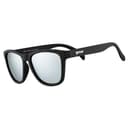
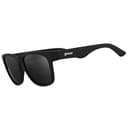
Start here, because it is the only decision with a wrong answer. goodr puts the size in the title: Medium Sized (OG) and Large Sized (BFG). There is no published number behind either word — goodr does not state a lens width, a bridge or a temple length on these listings, and its own sizing article was unreadable to us on the date of this review — so the only honest guidance is relative and symptom-based.
Buy the BFG if an OG, or any medium frame, does any of this: leaves a red mark or a dent at your temples after an hour; feels like it is squeezing the sides of your head rather than resting on it; puts the outer edge of the lens inside your field of view, so you can see the rim when you look ahead; or slides forward down your nose within half an hour even though the grip coating is doing its job. The last one is the counterintuitive symptom: a frame too narrow for your head has its arms sprung outward, which lifts the whole frame off your nose and lets it walk forward.
Stay with the OG ifa medium frame sits without pressure, or if anything medium already tends to slide down on you — because going up a size makes that worse, not better. A larger plastic front on a narrower face has nothing to grip. We cover that failure mode in why sunglasses slide down your nose, and the size guide explains how to read the three frame numbers when a brand does publish them. For heads at the wide end, the roundup for larger heads ranks frames on published width, which is something goodr does not give you; at the narrow end, the small-faces roundup does the same.
A note on the “OG small” searches. goodr has sold the OG in more than two sizes, but no small OG listing came back in stock when we searched on this date, so we have nothing to rank and no measurement to quote. If you need a frame narrower than a medium, the roundup above is a better starting point than waiting for one to appear.
Which lens finish, and why the plain one usually wins
All four finishes are polarized and all state UV400. The difference is what the lens does to the light that gets through, and goodr names the finish in the title.
Non-reflective glare-reducing (the plain one)
This is the default and the one to buy if you are buying one pair. No mirror layer, so nothing extra to scratch and nothing that shifts the color of what you are looking at beyond the tint itself. In a dark gray or black lens it is the most neutral thing goodr sells, which makes it the version that works for driving as well as running. Our guide to sunglass lens colors explains why a neutral gray is the right default and when it is not.
Mirrored reflective
A mirror coating bounces part of the light away before it reaches the tint underneath, so a mirrored lens is effectively darker than the same tint without one — genuinely useful in high, bright, reflective conditions like snow, sand or open water. The trade is that mirror coatings show scratches and smears far more visibly than a plain tint, and they cost the same as the plain finish here rather than more. If this is your only pair and you spend most of your time in ordinary daylight, the mirror is a styling choice you will pay for in scuffs. Full detail in mirrored sunglasses.
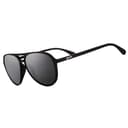
Gradient
Dark at the top fading lighter toward the bottom. The logic is sound for driving — dark where the sky is, clear enough at the bottom to read a dashboard — and it is the wrong lens for anything where the bright thing is below you, like water or snow. It is also the least useful of the four for running, because the bottom of the lens is where the road is.
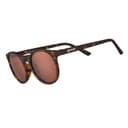
High-contrast copper
A warm tint lifts contrast and depth perception by suppressing part of the blue end of the spectrum, which is why copper and brown lenses are the standard choice for golf, trail running and anything where reading ground texture matters. The cost is color accuracy: everything looks warmer than it is. Our running roundup and golf roundup both get into when that trade is worth making.
What the OG does not do
It cannot be made to a prescription
goodr does not sell a prescription version of the OG, and the frame is not a format an optician will glaze. If you need correction, the two real routes are a dedicated prescription pair or a clip-on over your everyday glasses — compared in clip-on versus fit-over, with the options in prescription sunglasses.
There are no replacement lenses
“goodr OG replacement lenses” is a real search and the honest answer is that there is no first-party replacement lens for this frame; at thirty dollars the pair is the replaceable unit. That makes scratch avoidance the whole maintenance story, and the single most common cause of a scratched lens is cleaning it dry with a shirt. Our guides to cleaning sunglasses and storing them are short and will genuinely double how long a pair lasts, and repairs and replacement lenses covers which brands do offer them.
It is not a wraparound, and that has a coverage cost
The OG is a flat-fronted squared frame, not a wrap. The lens blocks UV properly — the listing states UV400 — but light still arrives from the sides and above the frame, and the American Academy of Ophthalmology recommends wraparound or oversized frames specifically so it cannot. For most running and everyday use that is an acceptable trade for a frame you will actually wear. For glacier travel, open water or sustained high-altitude sun it is not: read wraparound sunglasses or glacier glasses instead.
Is thirty dollars the right amount to spend?
For a pair you run in, yes, and the reasoning is not about value for money in the abstract. The two features that make a running sunglass work are a polarized or at minimum fully UV-blocking lens and a frame that stays on your face, and the OG has both. What more money buys above this price is optical quality across the whole lens, a frame that survives being abused for a decade, and fit options — none of which is a health difference once the UV rating is there. What less money buys is usually a listing that will not state its UV rating at all, which is the one thing we will not recommend.
It also matters that you will not mind losing it. A pair this price lives in a gym bag, a car door and a jacket pocket, which is where sunglasses actually get destroyed, and the premium pair you are careful with is the one that stays at home on the day you needed it. Our pages on whether expensive sunglasses are worth it and the best sunglasses under $50 make that case in full, and goodr versus Knockaround settles the head-to-head at exactly this price.