How to buy sunglasses for a small face
1. Learn to read the three numbers
Inside one temple arm you will find something like 52-18-140. Those are millimeters: lens width, bridge width, temple length. For a small face:
- Lens width 48–54mm. Standard adult frames run 55–62mm. Anything at 56mm or above will read oversized.
- Bridge width 14–18mm. This is the number that decides whether the frame slides. Too wide and there is nothing gripping your nose.
- Temple length 135–140mm. Standard is 145–150mm. A temple that is too long has nothing to hook behind your ear.
Total frame width matters most of all: roughly twice the lens width plus the bridge plus the frame rim thickness. Our sunglasses size guide works through the full arithmetic and shows how to measure a pair you already own and like, which is by far the fastest route to a good fit.
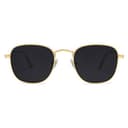
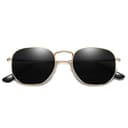
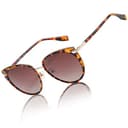
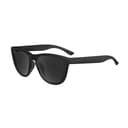
The catch is that most cheap frames never publish those numbers at all, which is what makes buying small online such a lottery. SOJOS — the brand behind both of the small frames picked above — is the notable exception in this price band: it lists lens width, bridge, temple length and lens height model by model on its own site. Our SOJOS review covers what else it does and does not disclose.
2. Check where your pupils land
The single best in-person test. Put the frame on, look straight ahead in a mirror, and see where your pupils sit within each lens. They should be roughly horizontally centered and slightly above the vertical center. If they sit noticeably toward the inner edge of each lens, the frame is too wide for your face — no amount of adjustment fixes that.
3. Do not confuse “small face” with “low bridge”
These are different problems that produce similar symptoms, and buying for the wrong one is why people go through five pairs without solving it.
- Small face: the frame is too wide overall. Temples splay, pupils sit off-center, the frame looks borrowed.
- Low or flat nose bridge: the frame width is fine but it sits too low — resting on your cheeks, touching when you smile, sliding down constantly. The fix is a bridge geometry change, not a smaller frame. Our low nose bridge guide covers the alternative-fit and low-bridge-fit frames built for it.
Plenty of people have both, which is why one pick above is a genuinely small frame that is also low-bridge fit.
4. Accept the coverage trade-off honestly
There is a real cost to a small frame and it is worth stating: less lens area means less of the delicate skin around your eyes is shaded, and more light reaches the eye from the sides and above. Both the AAO and the CDC recommend larger or wraparound frames precisely because of side-arriving light.
You cannot fully solve that with a small frame, but you can mitigate it: choose a frame that sits close to the face rather than standing off it, prefer a slightly deeper lens over a shallow one, and wear a brimmed hat when exposure is sustained. The AAO recommends a hat alongside sunglasses for exactly this reason.
5. Shape rules still apply
Small is a size, not a shape. Once you have the right dimensions, the usual face-shape logic decides which small frame — angular frames add definition to softer features, round and curved frames soften angular ones. Our face-shape guide has the rule, and the per-shape roundups for round, square, oval and heart-shaped faces go deeper.
What about children’s or teen sizes?
It is a legitimate route and worth knowing about, with one caveat. Youth frames are made in genuinely smaller dimensions and are often cheaper, and a large youth frame can fit a small adult face well. The caveat is lens spec: children’s eyewear listings are notably worse at publishing a UV rating than adult ones, and a fair number publish nothing at all.
If you go this route, insist on a stated UV400 or 100% UVA/UVB figure. Our kids’ sunglasses roundup covers which listings actually publish one.
Frames that tend to work at small sizes
- Small squares and rectangles. The most reliably available small shape, and the geometry stays flattering as it shrinks.
- Narrow cat-eyes. The 90s-revival narrow cat-eye is naturally small, which is the opposite of the oversized cat-eye that dominates the shape.
- Geometric and hexagonal frames. Angular facets add interest at a size where a plain frame can look plain.
- Thin metal. Visually light, which stops a small frame reading as fussy, and metal frames are the ones most likely to have adjustable nose pads.
What tends not to work: sport wraps, shields and oversized fashion frames, all of which are designed around coverage and get their proportions from being large.
Where to spend and where not to
Because the constraint here is dimensional rather than optical, this is a good category to shop cheaply and iterate — buy a $16 pair in the right measurements, wear it for a week, and learn what actually fits before spending more. Once you know your numbers you can buy anything with confidence.
Where premium genuinely helps is size variants and adjustability. Premium brands publish multiple sizes of the same model, and metal frames with adjustable nose pads let an optician tune the fit in two minutes. Our honest answer on expensive sunglasses covers what else the money buys, and our fit hub has the rest of the fit guides.