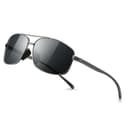
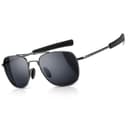
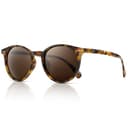
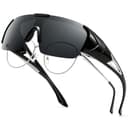
Are SUNGAIT sunglasses actually polarized?
The listings state it on most frames, and polarization is the one lens claim you can verify yourself in about a minute. Look at an LCD screen through one lens and rotate the glasses ninety degrees; a genuinely polarized lens will darken sharply or black out at one orientation. Or hold two pairs together and rotate one against the other — crossed polarizers go opaque.
Our polarization test guide covers four methods. Run one when your pair arrives. Anything that is genuinely polarized will pass immediately, and anything that does not pass should go straight back.
The important caveat: polarization does not imply UV protection. They are separate lens properties achieved in different ways, and passing a polarization test tells you nothing about ultraviolet. Our guide to whether polarized lenses block UV explains why, and why there is no home test for the second one.
Where SUNGAIT actually saves money
Hinges and frame metal
This is the honest answer and it is not the lens. The metal in a $16 frame is thinner and softer than in a $200 one, and the hinges are simple barrel or spring hinges without the machining tolerance of a premium frame. The practical consequence: the frame will hold its shape under normal use and will not survive being sat on, and after a year of daily wear you may find one arm slightly looser than the other.
Mitigate it by using the case, which is the same advice that applies at every price point — our care guide covers what actually destroys sunglasses, and it is mostly storage rather than use.
Coatings
Premium lenses carry multiple coatings: hard-coat for scratch resistance, anti-reflective on the back surface, sometimes hydrophobic. Budget lenses carry fewer, applied more thinly. You will notice this as scratching sooner than you expect, particularly if you dry-wipe the lenses — which is the number-one cause of scratches at any price.
Optical precision
A cheap polycarbonate lens is optically adequate rather than excellent. Hold any pair at arm’s length, look through it at a door frame and pan slowly — premium lenses hold the line dead straight to the edge, budget ones can show slight movement at the periphery. On a flat lifestyle frame this is a minor issue; on a steeply curved sport wrap it matters more, which is one reason we would take a SUNGAIT metal frame over its sport frame.
Plating and finish
The plating on the temple tips is where the wear shows first, particularly if you push the glasses up onto your head. Cosmetic rather than functional, but it is the thing that makes a cheap pair start looking cheap.
The 62mm frame is the real find
Most of the sub-$25 eyewear market is built to one width and that width is average. If you have a wide face, you already know this — every budget pair pinches, leaves marks behind your ears, and sits like a visor. The usual answer is to spend three figures on a frame from a brand that publishes size variants.
SUNGAIT’s SGT458 states a 62mm lens width, which is genuinely large, and it is polarized with a stated UV400 rating. That combination at this price is rare enough to be the single strongest reason to consider the brand. Our wide-face roundup covers the alternatives, and our size guide explains how to check the numbers against a pair you already own.
SUNGAIT vs the other budget brands
The sub-$40 tier has three distinct approaches and it is worth knowing which you are buying.
- SUNGAIT and Duco compete on lens spec per dollar — polarized, UV400, minimal branding, classic shapes. Our Duco review covers its near-identical proposition; the practical difference is that Duco is stronger on fit-overs and driving frames and SUNGAIT is stronger on sizing.
- SOJOS competes on information and catalog breadth rather than on lens spec — it publishes full frame geometry model by model and runs a prescription lens service, but states a UV rating on some frames and not others. Our SOJOS review works through where that leaves it against SUNGAIT.
- goodr and Knockaround compete on brand and sport function — no-slip coatings, colorways, a personality. They cost roughly twice as much and you are partly paying for that. Our goodr vs Knockaround comparison covers the pair.
- Tifosi competes on frame engineering — Grilamid TR-90, hydrophilic grips, photochromic options — at around $30-45. Our Tifosi review covers it.
If your priority is the cheapest honest polarized lens, SUNGAIT wins. If it is a frame that stays put during exercise, Tifosi or goodr. If it is a frame you will still own in ten years, none of them — that is the premium tier’s actual argument, and our honest answer on expensive sunglasses makes it properly.
The counterfeit angle, and why it matters here
One genuine advantage of a brand like SUNGAIT that is worth naming: nobody counterfeits it. Counterfeit eyewear is a large business built around premium logos, and a fake Ray-Ban reproduces the shape and the UV400 sticker with nothing behind either. An honestly cheap own-brand pair from a real manufacturer with a marketplace reputation to protect is a safer purchase than a suspiciously cheap premium-brand pair from an unidentifiable seller.
Our guide to spotting fake sunglasses covers the checks. The short version: buy cheap eyewear honestly, not expensive eyewear dishonestly.
Who should buy SUNGAIT
Buy them as a second, third or fourth pair — the one in the car, the one in the beach bag, the one you take somewhere you might lose it. Buy them as a first polarized pair to find out whether you actually like polarization before spending more. And buy them if you have a wide face and have been priced out of frames that fit.
Do not buy them as your only pair if you wear sunglasses daily for years, because the frame will not go the distance and re-lensing a $16 frame is not a thing anyone does. For that, our brands roundup covers who is best at what, and our under-$50 roundup covers the whole value tier side by side.