How to choose sunglasses for snow
1. Understand filter categories — this is the whole page
Sunglass lenses are graded from category 0 to category 4 by how much visible light they let through. Category 2 is an ordinary sunglass. Category 3 is a dark sunglass, which is what most quality lenses are. Category 4 transmits under 8% of visible light and exists almost entirely for glaciers, high altitude and sustained snow.
Two things people get wrong about this. First, the category describes visible light, not ultraviolet — a lens can be category 4 and say nothing useful about UV, and a category 2 lens can block 100% of UV. They are separate specs and you want both stated. Second, category 4 is genuinely too dark for driving and is not road-legal in a lot of jurisdictions. Our lens categories guide explains the whole scale and how to find the marking on a pair you already own.
2. Decide between a fixed dark lens and a photochromic
The choice depends on where you ski, not on budget.
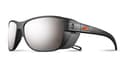
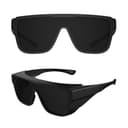
- Above the treeline, on snow, for hours. A fixed category 4 lens is the right tool. There is no light variation to accommodate and you want maximum, constant attenuation. The Camino and the budget glacier pick here are both this.
- Resort skiing with trees, lifts and cloud. A fixed category 4 is miserable — you will be lifting them every time you enter a wooded run. A photochromic lens that spans categories, or an ordinary category 3 sport lens, is far more usable.
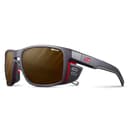
- Both, on the same trip. The Julbo REACTIV lens on the top pick is photochromic across categories 2 to 4, which is the only genuinely universal answer here and priced accordingly.
3. Block the light coming up from below
This is the detail that separates real mountain eyewear from ordinary sport wraps. On snow, a large share of the light reaching your eye arrives from underneath, reflected off the surface. A frame that only covers the front leaves that path open, which is why glacier glasses have side shields and why the good ones wrap tightly against the cheekbone.
Both the CDC and the AAO recommend wraparound frames for general sun protection because they block light arriving from the side; on snow that recommendation stops being general advice and becomes the point. Removable side shields are the best of both — on for the glacier, off for the drive home.
4. Sunglasses or goggles?
Honest answer: both, for different parts of the day. Goggles win when it is snowing, windy, or you are going fast downhill — they seal, they do not fog as readily with a helmet, and they protect the whole eye socket in a fall. Sunglasses win for skinning uphill, spring touring, walking around a resort and any time goggles would be too warm and fog immediately.
Ski tourers generally carry both and swap at the top. If you only buy one thing and you only ski lifts in winter, buy goggles. If you tour, hike glaciers or ski in spring, the sunglasses matter more.
5. Polarization on snow: useful, with one caveat
Polarization cuts the reflected glare off wet snow and ice, which is comfortable and helps you read surface texture. The caveat comes from mountaineers rather than skiers: a polarized lens can reduce the visual difference between hard ice and softer snow, which is a distinction that matters if you are choosing where to put a crampon. For ordinary skiing, polarized is a straightforward improvement. Our polarized vs non-polarized comparison covers the trade in general.
What snow blindness actually is
Photokeratitis is ultraviolet damage to the cornea — the clear front surface of your eye — and it behaves like sunburn, including the delay. You feel nothing at the time and it arrives six to twelve hours later as pain, watering, blurred vision and the sensation of grit in the eye. The AAO notes recovery usually takes one to three days and that treatment is mostly comfort while it heals.
The prevention is completely reliable: eyewear that blocks 99% or more of UV, worn from the start. It is not something you can catch up on after you notice symptoms, because by then the exposure has happened. This is also why children on a ski trip need proper eyewear rather than a novelty pair — our kids’ sunglasses guide covers what to check.
Where to spend and where not to
This is one of the few categories where the premium pick is genuinely worth it for a certain buyer. A photochromic category 2-4 polarized lens is doing something no cheap lens does — covering a whole day from a wooded approach to a glacier plateau on one lens — and if you tour regularly that convenience is real.
If you go to altitude once or twice a year, do not spend it. A fixed category 4 mountain lens costs a fraction of that and delivers the one thing you actually need, and a sub-$40 glacier frame with side shields covers a single big trip perfectly well. If glacier and high-altitude use is the whole reason you are shopping rather than one part of it, our glacier glasses roundup ranks that narrower category on its own terms, including the pair that fits over prescription glasses. For everything below the snowline, our hiking roundup covers altitude without the snow, and the sport hub has the rest of the activity roundups.