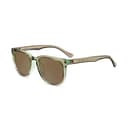
How to choose a wayfarer-style frame
1. Decide whether you are buying the shape or the badge
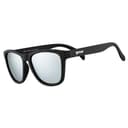
These are two different purchases and there is no shame in either. The badge is a genuine product: hand-assembled acetate, crystal G-15 lenses, a frame that an optician can heat-adjust to your head, and a design that will not look dated in five years. The shape is a $25–35 injection-molded frame with a polarized UV400 lens that does the optical job as well and that you will not grieve over when it goes missing at a barbecue.
What you should not do is pay for the badge while believing you are buying the optics. On the single spec that protects your eyes — ultraviolet filtering — the $30 pairs here and the premium ones are equivalent, and the American Academy of Ophthalmology is explicit that price does not equal protection. Our are expensive sunglasses worth it breaks down where the extra money genuinely goes.
2. Check polarization separately from UV, because they are separate things
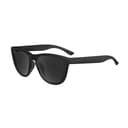
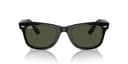
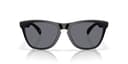
This shape is the clearest illustration on the whole site of why we insist on the distinction. The Ray-Ban RB2140 in standard trim: 100% UV, not polarized. The Knockaround Premiums at a fraction of the price: UV400 and polarized. The Oakley Frogskins in the gray trim we list: a Plutonite lens that blocks 100% of UVA, UVB and UVC to 400nm, not polarized.
UV protection is what stops cumulative damage to your eyes and it should be present on anything you buy. Polarization is a comfort and glare feature — it kills the reflected light coming off water, wet roads and car hoods. You want the first always; you want the second unless you spend your day reading LCD screens. Our polarized vs non-polarized comparison sets out the trade, and you can verify a pair you already own in a minute with our polarization test.
3. Know which faces the squared shape flatters
The wayfarer works by contrast. It is angular, wider at the top than the bottom, and heavy at the brow line, so it adds definition to a face that is soft or round and it balances a jaw that is narrower than the forehead.
- Round faces:the shape’s best case. The straight top rail and squared corners introduce the angles the face does not have. See best sunglasses for a round face.
- Oval faces:works, as almost everything does. Choose on size rather than shape — our oval-face guide covers the proportion rule.
- Square faces:the one to be careful with. Adding angles to an already angular face doubles down rather than balancing. If you love the look, take a rounded version like the softened pick on this list — or read best sunglasses for a square face first.
- Heart-shaped faces: depends on width. The flared temples emphasize a broad forehead, so keep the frame no wider than your face. See our heart-face guide.
4. Get the width right, because this shape is unforgiving
A wayfarer has a flat front and a hard corner where the rim meets the temple. On a face that is too wide for the frame, that corner presses; on a face too narrow, the frame front sits out past your temples and reads like a costume. There is very little middle ground, and unlike a wrapped sport frame there is no curvature to absorb the difference.
The original is sold in more than one lens width, so check the number on the specific listing rather than assuming. Our size guide explains how to read the three numbers printed inside the temple of a pair you already own and use them to buy blind. If you already know standard frames are too small for you, start at sunglasses for big heads and wide faces instead; if the opposite, our small-face roundup.
5. Material decides how it ages, and whether it can be fixed
An acetate wayfarer is heat-adjustable, which means an optician can bend it to your head and re-bend it when it drifts. An injection-molded polycarbonate one cannot be adjusted, but it also will not relax out of shape on a hot dashboard. Neither is better; they fail differently. Our frame materials guide covers the whole comparison, and our repair and warranty guide covers what happens when you scratch the lens — which no manufacturer’s warranty covers, whatever you paid.
Where the wayfarer is the wrong frame
It is flat. That is the point stylistically and the limitation practically. A flat lens with a low base curve leaves gaps at the sides, so light — and the ultraviolet reflected off water, sand and snow — comes in around the edges. Both the AAO and the CDC recommend wraparound coverage where sun exposure is the main event, and our base curve guide explains the geometry.
In practice: wear a wayfarer in town, in the car, at lunch outside and on the school run. Take something wrapped to the beach, the water and the mountain. Our beach roundup and sport hub cover those cases, and the aviator roundup covers the other heritage shape if angles are not what your face needs.
Counterfeits, briefly
No frame in the world is faked more often than this one, and the fakes have got good at the parts you can see. What they do not replicate is the lens, and a counterfeit UV400 sticker guarantees nothing at all. Buy the original from a seller you can identify as authorized — which is also the condition on Ray-Ban’s 24-month warranty — and read our guide to spotting fake sunglasses before you take a bargain. On the wayfarer-style pairs there is nothing to counterfeit, which is a small, underrated advantage of buying the shape rather than the badge.
The top two frames here are the whole argument of this shape in miniature, and we have put them head to head in Knockaround Premiums versus Ray-Ban Wayfarer— where the surprise is that the cheap pair is the polarized one.