What NEVEN is actually selling
Fit, first and foremost. The three-number sizing convention printed inside a temple arm — lens width, bridge width, temple length — exists because frames are not one-size, and most brands cluster their frames within a narrow band around the average. If your face sits outside that band, an entire industry has quietly excluded you.
NEVEN’s answer is to design only for the upper end. That means you can shop the whole range rather than filtering for the one XL SKU, and it means the frame geometry is proportioned for a larger face rather than scaled up from a standard one — a distinction that shows in how a frame sits rather than in any measurement. Our size guide explains how to work out whether you are in this group before spending anything.
The lens question, stated plainly
Polarization is consistent across the range and clearly stated, which is the good news. Polarized is not the default at any price point — the standard Ray-Ban Wayfarer and most Oakley Holbrook trims are not polarized — so a brand that polarizes by default is doing something worth crediting.
Ultraviolet is where it gets uneven, and we are going to be direct about it because it is the one specification that affects your eyes rather than your comfort:
- Doc Robbins: states UV400. That is the full claim and it is what you want.
- Tombstone: states UV protection without a figure. That is not the same claim, and our product card records it as not published rather than assuming.
- Legend shield: states no UV rating at all.
This is fixable by the buyer in one message: ask the brand what the UV transmission is before you order, or have the lens read by an optician afterwards, which takes under a minute and is usually free. Our UV testing guide covers exactly how. What you should not do is assume a polarized lens implies UV filtering — they are unrelated properties, as our answer on the subject explains.
The three models, and how to choose between them
Doc Robbins — the default
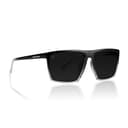
A rectangular frame with a squared front, and the model to buy if you are not sure. The shape adds horizontal width, which suits a long face as well as a wide one — see our long face guide — and it is the only one of the three with a clean UV400 statement.
Tombstone — the same fit, softened
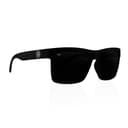
A relaxed rectangular shape with less severe corners. Choose it over the Doc Robbins if your face is already angular, because adding hard corners to a square jaw doubles down rather than balancing — the reasoning in our square face guide. The UV disclosure is weaker here.
Legend — the shield, and the interesting one
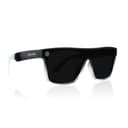
A single-lens shield on a TR90 frame in a large fit is a combination that barely exists elsewhere. Shields are usually cheap novelty frames or expensive sport eyewear, and large-fit shields are close to nonexistent.
The functional argument for a shield is real: continuous coverage with no bridge in your sightline, and no gap where the frame front meets the temple. The AAO recommends wraparound styles precisely because that gap is where reflected light gets in. The argument against, other than the styling commitment, is that this model publishes the least about its lens. Our base curve and wrap guide covers what a heavily wrapped lens costs you optically at the edges.
How NEVEN compares
Against Oakley, the honest comparison is that Oakley’s sizing range is the most systematic in the industry — genuine size variants and low-bridge-fit versions of several frames, with Plutonite lens material that filters 100% of UVA, UVB and UVC to 400nm regardless of tint, stated plainly. If you want a large frame with a published lens standard, an Oakley Holbrook XL is the more transparent purchase. It is also several times the price, and most Oakley trims are not polarized. Our Oakley review covers the range.
Against the budget tier, brands like SUNGAIT and Duco state UV400 clearly at a fraction of NEVEN’s price but do not size for large heads. That is the real trade here: you are paying a premium for fit, not for spec. Whether that is worth it depends entirely on whether standard frames actually fit you — if they do, this is not the brand for you.
Against goodr and Knockaround, both of which polarize by default and state UV400, the same point applies. Our goodr vs Knockaround comparison covers that end of the market, and our brands roundup sets out the whole field.
Our verdict
NEVEN is solving a real problem that the mainstream ignores, and solving it with polarized lenses rather than cutting that corner. If standard frames leave marks on your temples, that is genuinely worth paying for and there are few alternatives.
What stops us recommending it unreservedly is the UV disclosure. At this price, a stated lens standard should not be something the buyer has to chase, and the fact that the brand’s own most-covered frame is the one publishing least about its lens is exactly backwards. Buy the Doc Robbins if you want the clean claim; ask the question first if you want either of the others.