How to choose sunglasses for an oval face
1. Match the frame width to your face width
This is the single most useful rule and it applies to every face shape, but for an oval face it is doing most of the work. The total width of the frame — temple hinge to temple hinge — should sit close to the widest part of your face, which on an oval is usually the cheekbones.
Too narrow and the frame pinches visually, making your face look wider than it is. Too wide and it reads as borrowed. The measurements printed inside the temple are how you check this before ordering; our sunglasses size guide explains how to read them and how to measure a pair you already own and like.
2. Keep the lens height in proportion
An oval face has moderate vertical distance between the brow and the cheekbone. A very tall lens fills that space and shortens the face; a very shallow lens leaves a strip of skin above and below that reads as unbalanced. Aim for a lens that covers roughly from eyebrow level to the top of the cheekbone.
Practical check: the frame should not touch your cheeks when you smile, and your eyebrows should sit just above the top rail rather than being covered by it.
3. Center your eyes in the lens
Your pupils should sit roughly in the middle of each lens horizontally and slightly above center vertically. If they sit toward the inner edge, the frame is too wide; toward the outer edge, too narrow. This one check catches most fit errors faster than any shape rule.
4. Now pick a style, because you genuinely can
With proportion handled, an oval face has an unusually free choice. Some reasonable starting points:
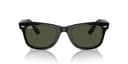
- Angular acetate — a Wayfarer-style front adds a little structure and reads as classic rather than trend-led.
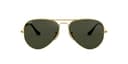
- Metal aviator — the teardrop follows the natural line of an oval face closely, which is why it looks effortless on this shape.
- Round — a genuinely round lens works here where it would soften a round face too far. Ours square-face roundup covers where round is the corrective choice rather than a free one.
- Cat-eye — the upsweep lifts, which on a balanced face reads as styling rather than correction. Our cat-eye roundup has the full range.
5. Avoid the two extremes
The only shapes that genuinely fight an oval face are the ones that break its proportion: a very tall, very deep oversized lens that shortens the face, and an extremely narrow shield or visor style that elongates it. Both are style choices you can make on purpose; neither is a default.
Do not let shape decide the lens
Fit guides tend to stop at the frame, which is backwards. The lens is the product and the shape is the packaging. Before you commit to a frame because it suits your face, check three things:
- UV. A stated UV400 or 100% UVA/UVB figure. The American Academy of Ophthalmology is explicit that lens darkness and price are not proxies for protection. Our UV guide covers the label wording.
- Polarization, if glare is a problem where you live or drive. Note that several heritage classics — including the base Wayfarer and base Aviator — are not polarized in their standard trim. Our comparison covers the trade.
- Coverage, because the AAO and CDC both recommend larger or wraparound frames for the simple reason that they block more light arriving from the sides.
What if you are not sure your face is oval?
Quick method: pull your hair back, look straight into a mirror, and compare three widths — forehead, cheekbones, jaw. An oval face has cheekbones as the widest point, a forehead slightly wider than the jaw, and a face length noticeably greater than its width, with a softly rounded chin rather than a squared one.
If your jaw is as wide as your cheekbones and squared off, you are closer to a square face and the advice inverts — see our square-face picks. If your face is close to as wide as it is long with full cheeks, see our round-face picks. The full method for all shapes is in our face-shape guide.
Where to spend and where not to
Because an oval face is not relying on the frame to correct anything, this is a category where you can shop entirely on lens spec and budget. A $25 polarized pair with a stated UV400 rating protects your eyes exactly as well as a $250 one — our honest answer on expensive sunglasses covers what the premium actually buys.
What the premium tier does give you here is frame longevity and lens quality: hand-set acetate that an optician can adjust and re-lens, and a lens that lifts color rather than just dimming it. If you expect to wear one pair for a decade, that is a defensible spend — our brands roundup covers who is best at what. For the rest of the fit questions, our fit hub has size, slippage and face-shape guides.