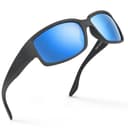
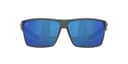
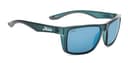
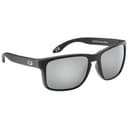
How to choose sunglasses for guarding
1. Polarized, and it is not optional
Every other buyer on this site treats polarization as a preference. You do not. Light reflecting off a water surface arrives horizontally polarized, and a polarizing filter is oriented to block exactly that component — the AAO’s explanation is that polarized filters block horizontal glare while letting vertical light through, and its guidance names reflected glare from water as the problem they solve. Strip that reflected layer away and you are looking into the water instead of at it.
That is the whole argument, and it is why every pick on this page states polarization. A dark non-polarized lens makes the surface dimmer without making it any more transparent, which is the opposite of what your shift needs. Our polarized vs non-polarized guide has the longer version, and how to tell if a lens is polarized is the test to run on a pair you were issued.
2. Tint: copper and brown over grey, for this one job
Grey keeps colour true and is the right everyday choice. For looking into water, a copper, brown or amber base is the common preference because it lifts contrast between what is in the water and the water itself — the same reasoning that puts those tints on every fishing frame we rank. Costa’s 580 lens family is built around filtering a specific band of light to raise contrast, and a gray-blue mirror on top of it cuts the transmitted light further.
In a pool the calculation shifts slightly: the water is clearer, the bottom is a known colour, and the problem is more often surface glint off a flat sheet of water in a shaded hall than deep-water contrast. Polarization still wins; tint matters less. Our lens colours guide covers what each tint does.
3. A full shift, not an afternoon
Six to eight hours changes the specification. Weight and nose-bridge pressure that are invisible in an hour become the reason a pair ends up on your head instead of your eyes by mid-afternoon. Two things to look for: a frame light enough that you forget it, and grippy temples or hydrophilic pads that hold better as you sweat rather than worse.
The second half of a long shift is also when UV exposure adds up, and yours is an occupational dose. The AAO’s position is that UV exposure raises the risk of cataract, growths on the eye and eye cancer, and reflected light off water adds to what arrives from the sky. This is one of the few pages on this site where every single pick states a UV figure — UV400 or 100% UV on all five, and one of them states UVC as well — which is less a compliment to our shortlist than a sign that eyewear sold for the water takes the rating seriously. Our UV protection guide covers what the ratings mean, and whether sunglasses prevent cataracts covers the long-run question specifically.
4. Retention, and what happens when you go in
Two different problems. The first is keeping them on while you watch — a cord or a grippy temple solves it for a few dollars. The second is what happens when you enter the water at speed, and the honest answer is that they come off. No sunglass stays on through a surf entry.
That is the case for a floating frame, and it is a real one: a pair that surfaces is a pair you can retrieve after the incident rather than replace. Two of the picks below float, and one of them comes from a brand that builds specifically for the water — our Hobie review sets out what the company publishes about its lenses, including a 100% UVA, UVB and UVC claim, and what it does not. It is also the case against spending a lot: the best lens on this page is the one you would least like to watch sink. If floating is your priority, our floating sunglasses roundup ranks the whole family on that single criterion.
5. Salt, chlorine and sand
All three are abrasive or corrosive and all three end pairs. Rinse with fresh water at the end of a shift, dry with a microfibre cloth rather than a shirt, and never wipe a sandy lens dry — that is grinding, not cleaning. The AAO’s own advice on cleaning glasses is to rinse first for exactly this reason, and it also makes the reassuring point that a scratched lens will not damage your eye, though it can cause strain. Chlorine is harder on frame hardware than on lenses; salt is harder on hinges. Our cleaning guide covers the routine, and our beach roundup covers the sand problem for people who are there by choice.
Pool, beach or ocean: what changes
Pool. Flat water, often partly shaded, chlorine rather than salt. Polarization for the surface glint, less weight on tint, and a frame whose hardware tolerates chemical exposure. Cheap and replaceable is a perfectly good strategy here.
Beach.Sand is the enemy of the lens and reflected light off both wet sand and water is the enemy of your eyes. Prioritise coverage — the AAO recommends wraparound or oversized frames specifically so light cannot arrive from the side — and accept that you will be replacing pairs. The closest thing on this site to a beach-sand stress test is our beach volleyball roundup, which ranks on grip and on surviving sand specifically, and several of those frames would serve a beach guard well.
Ocean.The hardest case: salt, surf entries, distance scanning and long exposure. This is where a floating frame earns its keep and where the best lens on the page genuinely pays for itself, if you can live with the risk of losing it. Many guards we would expect to run two pairs — a good one on the chair and a cheap one for the water.
What we checked and did not feature
Glass lenses.Costa’s 580G glass is optically the clearest thing we cover and the wrong choice for this job: it is heavier on a long shift and it is brittle where polycarbonate is impact resistant. Our Costa Fantail vs Blackfin comparison works through that trade inside one brand, and glass vs polycarbonate covers it across the market.
Safety-rated eyewear. Our ANSI Z87.1 roundup ranks certified impact-rated sunglasses, and they are not what this job needs. Impact certification is for flying debris; your hazard is water and sun. Buying Z87.1 here costs you lens quality for a protection you are not using.
A second premium Costa and a second floating budget pair. Both exist in our registry, both are sensible, and both would have been the fifth and sixth entries saying the same thing as the second and fourth. We would rather the five picks be five different answers. They are ranked on boating and floating respectively.
Sunglasses as eye protection for rescue work. Prevent Blindness is explicit that ordinary sunglasses are not sports eye protectors, and the same logic applies here: nothing on this page is protective equipment for a rescue. It is eyewear for the ninety-five percent of the shift you spend watching.