The one thing that separates a good cheap pair from a dangerous one
Your pupil responds to brightness. In strong sun it constricts, which limits how much light — including ultraviolet — reaches the back of your eye. Put a dark lens in front of it and your pupil opens back up, because as far as your eye is concerned the world just got dimmer. If that lens filters UV, this is exactly what you want: a wide pupil behind a protective barrier, comfortable and safe. If it does not, you have removed the brightness cue while leaving the ultraviolet, and you are letting more UV in than you would bare-eyed.
The WHO attributes a meaningful share of cataracts worldwide to ultraviolet exposure, and the FDA regulates sunglasses as medical devices for related reasons. None of this means you need to spend money — it means you need to read one line on the listing. Look for UV400 or 100% UVA/UVB, and if it is not stated, treat it as absent. Our UV protection guide covers the labeling rules and the loopholes.
What $30 gets you now that it did not ten years ago
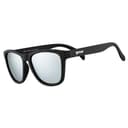
The genuinely surprising development in this category is polarization. A decade ago it was a premium feature; today a $25 pair from goodr or Knockaround carries a real polarizing filter, and it works the same way the one in a $250 lens does — it removes the horizontally oriented light bouncing off flat surfaces, which is what turns a lake into a mirror and a wet road into a sheet of white.
The optical difference between a $30 polarized lens and a $300 one is real but subtle: edge clarity, color rendering, how neutral the tint stays. The difference between a $30 polarized lens and a $300 non-polarized one is not subtle at all — the cheap pair wins outright at the job you notice most. That is worth sitting with before you spend, and our polarized vs non-polarized guide explains the mechanism.
What you are actually giving up
We would rather be straight about the ceiling than pretend budget frames are premium ones in disguise. Four honest compromises:
- Coatings scratch faster. Budget anti-scratch layers are thinner. A pair that lives loose in a bag will show swirl marks within a season, where a hard-coated premium lens takes years. A $3 hard case does more for lens life than $200 of upgrade.
- Edge clarity is softer. Cheap lenses are less precisely decentered, so the outer portion of your field can show slight distortion. Most people never notice this; anyone who has worn a good lens does.
- One size, no adjustment. Almost every pair here comes in a single fit with no adjustable nose pads. Very narrow or very wide faces are poorly served, and there is nothing to fall back on. Our size guide helps you check before you buy.
- Hinges are the failure point. Not lenses, not frames — hinges. Budget frames typically die at the temple joint, usually after being pushed on and off a head one-handed a few hundred times.
How to spot a bad cheap pair in ten seconds
- No stated UV rating. This is disqualifying. Reputable budget brands advertise UV400 loudly because it sells; silence means absence.
- “Polarized” with no other spec. Some listings use the word decoratively. If you already own the pair, our one-minute polarization test settles it — hold them in front of a phone screen and rotate them ninety degrees.
- A mirror coating sold as protection. A mirror finish reduces how much light gets through and looks good; it is not UV protection and it is not polarization. Our mirrored lens guide explains what it does and does not do.
- Visible distortion. Hold the pair at arm’s length and look through the lens at a straight line — a door frame, a window edge. Move the glasses slowly. If the line bends or wobbles, the lens is poorly made.
When cheap is the correct answer
Buying budget is not always a compromise; sometimes it is straightforwardly the right call. If you lose sunglasses regularly, a $25 pair you replace without a second thought protects your eyes better over a year than a $250 pair you left on a bar in March and never replaced. If you spend real time on the water, a cheap polarized pair as a backup means you are never stuck squinting. And if you want a second color, a second shape, or a pair for the car, the budget tier is where that lives.
Where we would push you upward: if you fish or boat seriously, glass and tuned contrast tints genuinely change what you can see — our fishing roundup and Costa review cover that. If you golf, tint tuning matters more than price, and our golf roundup explains why. And if you want one frame to last a decade, that is a build-quality purchase the budget tier cannot make — our is it worth it piece works through where the money actually goes.
For the head-to-head between the two best budget brands, see goodr vs Knockaround. And if the hard part of your purchase is fit rather than lens spec, our SOJOS review covers the one brand in this tier that publishes full frame measurements model by model — along with the reason its UV disclosure needs checking pair by pair.
The one case where cheap is the correct answer, not the compromise
Everything above argues that a cheap pair can be good enough. There is one situation where a cheap pair is actively the right purchase rather than an acceptable one, and that is travel: the thing that ends a holiday pair is losing it, not wearing it out. Our sunglasses for travel roundup ranks on that logic and ends up recommending two cheap pairs over one good one.
The cheap brand that documents its lenses best
If what frustrates you about this price bracket is how little the listings tell you, there is one brand worth knowing. KastKing is a fishing-tackle company, and it publishes a lens material, a thickness in millimeters, a named coating and a stated use for each tint — more than several hundred-dollar eyewear brands put on a product page. The catch is that its own figures differ between models, so the badge does not tell you what you are getting. Our KastKing sunglasses review compares those spec sheets directly. And for the single most-recommended pair at this price, our goodr OG review covers the two things that actually decide whether yours fits: the frame size, and the lens finish.