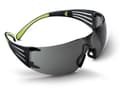
How to choose shooting and hunting eyewear
1. Find the marking on the frame, not the claim in the listing
ANSI Z87.1 is the American standard for occupational and educational eye protection, and compliant eyewear is marked. Look at the temple arm near the hinge:
- Z87 — meets the basic impact requirement.
- Z87+ — meets the high-velocity impact requirement. This is the one you want on a range.
- A manufacturer’s mark alongside it — OSHA has been explicit that protective eyewear must be permanently marked so it can be identified. An unmarked lens is an unverifiable lens.
A listing that says “impact resistant” without a marking is telling you the lens is polycarbonate, which is true of almost every sunglass lens sold and is not the same claim. Our safety sunglasses roundup covers the full marking system, including what the letters after the rating mean.
2. Tint is the performance decision — and it changes by discipline
This is where shooting genuinely differs from other sports. You are not trying to see comfortably; you are trying to make one object jump out of a background you already know. That makes the right tint specific rather than general.
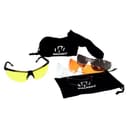
- Amber and yellow:block blue light, which lifts contrast and makes things look brighter in flat or overcast conditions. The classic choice for clays against a gray sky and for dawn and dusk in the field. The cost is heavy color shift — useless if you need to judge color accurately.
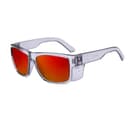
- Vermillion, rose and purple: the specialist clay tints. They suppress the blues and greens of sky and treeline while leaving orange targets bright, which is a narrower and more effective version of what amber does.
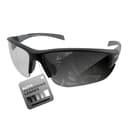
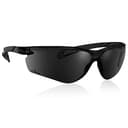
- Gray and smoke: the neutral option for bright open ranges. Dims everything evenly, keeps color honest, and is right when the problem is too much light rather than too little contrast.
- Dark green:a middle ground — some contrast lift with less color distortion than amber. OSHA lists it among the tints it has accepted as equivalent to Z87.1 protection.
- Clear: not a fallback but a real option, and the right one for indoor ranges and low light, where you need the protection and none of the dimming.
Our lens colors guide covers what each tint does to the spectrum in general terms; the shooting-specific point is that the useful tint changes with the target and the background, which is the argument for a lens kit.
3. Buy a kit if you shoot in more than one condition
A four-lens set costs less than one mid-tier frame and solves the problem properly. You take the amber lens for an overcast morning, the smoke for a bright afternoon and the clear for the indoor range, and you stop compromising. The trade is handling: every lens change is a chance to scratch or fingerprint a lens, so a kit needs a case you actually use.
The alternative is a photochromic lens that darkens and clears on its own. It is a genuinely good answer for hunting, where light changes across a morning and swapping lenses is impractical. It is a poor answer for an indoor range, because photochromics are triggered by ultraviolet and indoor lighting has none. Our photochromic guide covers the limits.
4. Polarization: useful in the field, contested on the range
For hunting near water, a polarized lens is a clear win — it cuts the surface glare that hides everything on and below it. Walk-up shooting in wet grass benefits too.
On a range it is more debatable. Polarization can alter how a target face and a metal plate reflect, and some clay shooters find it changes the way a target reads against the sky. Neither effect is dangerous; both are personal. If you shoot both disciplines, an unpolarized amber lens and a polarized gray lens between them cover almost everything. Our polarized vs non-polarized comparison sets out the general trade.
5. Check it works with your ear defenders
The most common practical failure, and the one nobody checks in the shop. A thick temple arm breaks the seal of an over-ear defender, and a broken seal means the muff is doing far less than it should. You end up choosing between hearing protection and eye protection, which is not a choice anyone should have to make.
What works is a thin, flat temple designed to sit under a cup. Several manufacturers make them for exactly this reason. If you use in-ear plugs the problem disappears, but most people on a range are wearing muffs.
6. UV still matters, and Z87 says nothing about it
An impact rating and an ultraviolet rating are entirely separate specifications. A lens can be Z87+ rated and filter no UV at all — the standard is about impact, not radiation. A day at an open range or a day in a field is a full day of sun exposure, and the AAO is clear that UV damage is cumulative.
So check for both: a Z87 marking on the frame and a stated 100% UV or UV400 figure for the lens. Where a listing does not publish a UV figure, our product cards say so rather than filling the gap. Our UV protection guide explains what the label covers.
Hunting has one extra requirement: low light
Most field shooting happens in the first and last hour of daylight, which is the exact opposite of the bright-sun problem sunglasses are usually solving. A dark lens at dawn is actively dangerous — it costs you the ability to identify what you are looking at.
In that light, a yellow or light amber lens is the right tool. It transmits most of the available light while lifting contrast in flat conditions, which helps you separate an animal from cover. What it does not do, despite decades of marketing, is help you see in the dark; nothing tinted can. The same reasoning applies to the yellow lenses sold for night driving, and our night driving glasses guide covers why the authorities advise against them.
Where to spend and where not to
Spend on the marking and on a lens set. A Z87+ frame with three tints costs less than one fashionable sport pair and does the job properly.
Do not spend on a premium engineered tint for occasional shooting — the gain over a plain amber lens is small and the price difference is not. And do not treat an unmarked lens as protection because it is polycarbonate. Polycarbonate is the right material, but the rating is what tells you the whole assembly, frame included, has been tested. Our safety sunglasses guide covers the standard in detail, and the sport hub has the rest of the activity roundups.