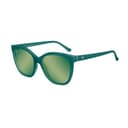
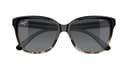
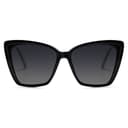
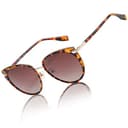
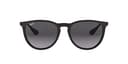
How to choose a cat-eye
1. Check the lens before the colorway
It is the reverse of how the category is sold, and it is the right order. Two questions, both answerable from the listing:
- Does it state a UV figure? UV400, 100% UVA/UVB, or “UV absorption up to 400nm” — the American Academy of Ophthalmology accepts all three phrasings. If the listing states nothing, treat the pair as unprotected. Our UV protection guide covers the wording.
- Is it polarized? Optional rather than essential, but it is the difference between a frame that is comfortable at the beach and one that is not. Unlike UV, you can verify it yourself in a minute with our polarization test.
A pair that states both is not a compromise on style — two of the picks here do it under $35.
2. Decide oversized or narrow, because they suit different faces
The cat-eye splits into two quite different shapes that share a name.
- Oversized cat-eye. A large lens with a soft upsweep. Covers more of the delicate skin around the eye, which is a genuine protective advantage, and reads as glamorous rather than sharp. Needs a face with enough width to carry it.
- Narrow cat-eye. The 90s-revival cut — a shallow, slim lens with a pronounced point. Sharper and more graphic, and the better option for a small face, which an oversized frame swallows. The trade-off is less lens area and therefore less coverage.
3. Know which faces the upsweep flatters
The cat-eye is a corrective shape. It adds width and lift at the temples and draws the eye upward and outward, which balances a face that is wider at the bottom or softer in the middle.
That means it works well on round faces — the angles add definition — and on square faces in its softer, more curved versions. On an oval face it is a free style choice rather than a correction.
Where it fights you: a heart-shaped face, which is already widest at the forehead and temples — an upswept frame emphasizes exactly that. If that is your shape and you love the look, choose the softest, least pointed version you can find, or take the alternative pick on this list instead. Our face-shape guide has the full method.
4. Watch the temple width
Because the cat-eye points outward, the widest part of the frame is at the hinge rather than at the lens center. A frame that measures fine on lens width can still extend past your temples once the upsweep is accounted for. Check total frame width rather than lens width alone — our size guide explains how to work it out from the numbers printed inside the temple.
5. Acetate weight and where it sits
Most cat-eyes are acetate, which is heavier than thin metal and has a molded bridge that cannot be adjusted. If your sunglasses habitually slide down, an acetate cat-eye is one of the harder shapes to solve — there are no adjustable pads to work with. Our guide to sunglasses sliding down covers the options, and if the cause is a low bridge, our low nose bridge guide covers what actually works.
Is a cat-eye a summer-only frame?
It has a reputation as a beach and holiday shape, and the oversized versions do lean that way. But the narrow 90s cut reads as urban rather than resort, and a plain black or tortoise acetate cat-eye in a moderate size is as year-round as a Wayfarer.
If you want the shape to work for driving as well, the specification to prioritize is a neutral or bronze polarized lens rather than a heavily mirrored or gradient one — a gradient lens is lighter at the bottom, which is pleasant for reading a dashboard and less effective against low sun. Our driving roundup covers the lens logic.
Where to spend and where not to
The value case is unusually strong here. A $14 oversized cat-eye that states polarization and UV400 protects your eyes as well as a $289 one — the AAO is explicit that price is not a proxy for protection — and the cat-eye is a shape with more fashion cycle in it than a Wayfarer or an aviator. Buying cheaply and replacing when the shape moves on is a defensible strategy.
The premium argument is narrower but real: a genuinely tuned polarized lens that lifts color rather than dimming it, in a frame an optician can adjust and re-lens. If you want one cat-eye you will wear for years and you drive a lot, that is worth it — our Maui Jim review covers what the lens actually does and our answer on expensive sunglasses covers the general case.
For more of the everyday range, our women’s roundup covers the wider field, our everyday hub has the budget and gift picks, and our aviator roundup is the other shape-led list.