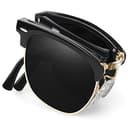
How to choose a browline frame
1. Understand what the brow is doing
On a conventional frame the rim runs all the way around the lens, so the lens is supported on every edge and protected on every edge. A browline frame deletes the bottom two-thirds of that rim. The brow across the top carries the lens, the hinges and the whole weight of the frame, and the lower edge of the lens is left exposed to the world.
Two consequences follow, and they are the trade at the heart of the shape. The good one: nothing crosses the lower half of your field of view, so looking down — at a phone, a step, a dashboard — is unobstructed in a way it is not through a full rim. The bad one: the bottom lens edge is the first thing that touches a table, and there is no rim to take the hit. This is the same trade our rimless roundup covers in its more extreme form, where the rim is gone entirely. A browline is the moderate version: it keeps the rim exactly where it does the most structural work and the least visual damage.
2. Brow thickness is the entire look
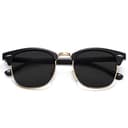
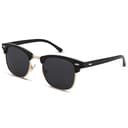
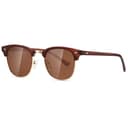
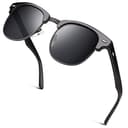
This is the specification nobody lists and everybody judges you on. A thick, matte, horn-style brow is what makes the shape read as the classic frame. A thin wire brow with a narrow plastic strip on top makes the same construction read as a modern half-frame, which is a perfectly good look but a different one. Both appear in this category at the same price, and the listing photos are the only way to tell them apart, because no listing describes the brow in millimeters.
If you are buying the shape for the shape, buy the thicker brow. Our top pick is the one frame here whose listing describes the brow as “horn rimmed”, which is the vocabulary the original uses, and it looks like it.
3. The bridge is the only fit lever you get
A browline hangs from the top rail and the bridge. That makes bridge fit more consequential here than on a wrap or a sport frame, which spread their contact across a nose pad, a brow and two temple arms. If the bridge is slightly wide for you, a browline slides, and once it slides the brow sits below your natural brow line and the whole look collapses.
Only one frame in this group gives you any adjustment at all: the GQUEEN, which states adjustable nose pads. If your sunglasses slide, that is the pick, and it is the reason it earns a slot over several near-identical frames. If you already know your bridge runs low or wide, read our guide to low nose bridges first — it is the single most common reason a frame that looks right in photos does not stay up on your face. Our sizing guide explains how to read the three numbers on a frame when a listing bothers to publish them, which in this category none of them do.
4. UV400 is the floor; polarization is the upgrade
The American Academy of Ophthalmology is explicit that price is not a proxy for ultraviolet protection, and Prevent Blindness tells shoppers to buy only sunglasses carrying a clear statement of UV blocking. That is a usefully blunt standard for a category like this one, because it means a twelve-dollar frame that states UV400 has satisfied the thing that actually protects your eyes, and a premium frame with no reachable statement has not satisfied it for you — whatever is true inside the lens.
Every pick on this page states a UV figure. Four of the five also state polarization, which is a separate feature doing a separate job: it strips reflected glare off flat surfaces like wet roads and car hoods, and it has nothing to do with ultraviolet. If that distinction is new, our polarization and UV explainer is the three-minute version and what UV400 means is the number itself.
The Clubmaster, and why it is not one of our picks
The Ray-Ban RB3016 Clubmaster is the frame this entire category copies. It is currently listed and in stock at a premium price, around twenty times what the picks above cost, and it is a genuinely well-made acetate-and-metal frame from a brand whose lenses have a strong reputation. We are not ranking it, and the reason is worth stating plainly rather than burying.
We could not reach a source that states its UV protection. The Amazon listing title gives the model, the colorway and a 51mm lens size and no UV figure. Ray-Ban’s own product page for the RB3016 returned HTTP 403 Forbidden on the date we checked, and so did the same frame on Sunglass Hut. Our rule is that every pick must have a UV figure stated by a source we actually read, and we apply it to premium frames and ten-dollar frames identically — which is the only way a rule like that means anything. It is the same reason two cheap frames further down are not picks either.
None of which is a claim that the Clubmaster lacks UV protection. Ray-Ban states full UV blocking across its lens range in material we have cited elsewhere on this site, and our Ray-Ban review covers the brand on the evidence we have. It is a claim about what we can verify today for this specific frame, and it is a small, real illustration of a bigger problem: the most expensive frame in a category is often the hardest one to get a published specification out of, because heritage brands sell on name and the cheap sellers sell on feature lists.
If you want the original and the price is not the obstacle, buy it — we would rather say that than steer you to an imitation for the sake of a commission. If the price is the obstacle, the frames above are the honest version of the answer, and the top pick is the one that looks most like it.
What nobody in this category publishes
We read the listing for every browline frame we could find. Across the whole category, here is what is missing:
- Weight. Not one frame publishes a gram figure, in a shape sold partly on being light. This is the ninth consecutive category where we have hit the same wall.
- Frame measurements. No lens width, bridge width or temple length on any of the five picks. The one frame that publishes a number is the Clubmaster, at 51mm, and it is not a pick.
- Lens material. Stated by exactly one frame here, the AEVOGUE, which says polycarbonate. In a shape with an exposed lower lens edge, the impact-resistant material is the one you want, so that single disclosure is why that frame has a slot.
- Lens category or light transmission.Nothing, anywhere. If you need a known filter category — for very bright conditions, or at altitude — this is the wrong shape to shop, and our lens category guide explains what the numbers mean and which frames state them.
We could have filled those gaps with plausible numbers. We do not publish a figure a maker has not published, so the spec tables above say “Not published” a lot. That is the honest shape of this category rather than a gap in our research.
Two frames we dropped, and why
A SUNGAIT retro semi-rimless and a KALIYADI semi-rimless were both in stock, both inexpensive, both well reviewed and both genuinely rankable on looks. The SUNGAIT states polarized lenses and no UV figure. The KALIYADI says “UV blocking”, which is a direction rather than a specification. Neither cleared the floor, so neither is a pick, and we mention them because a shopper comparing this page against a marketplace search will see both near the top and deserves to know they were considered. SUNGAIT in particular makes frames we rank elsewhere — see our SUNGAIT review — and the brand publishing UV on some listings and not others is exactly the inconsistency the AAO warns shoppers about.
Browline, rimless or rectangular?
These three get confused constantly, so here is the separation in one place. A browline is a construction: a rim across the top, nothing underneath. A rimless frame has no rim at all, with the arms bolted through the lenses or attached to one continuous lens. Rectangulardescribes the lens shape and says nothing about how the frame is built — a browline is usually rectangular-ish, but so are plenty of full-rim frames.
In practice: choose browline for the look and the open lower field, rimless for the lightest possible frame and the most open view at the cost of fragility, and a full rim if you are hard on your sunglasses. The rimless roundup and the rectangular roundup both rank picks against those priorities, and one frame — the Pro Acme semi-rimless — earns a place on this page and that one, because it genuinely sits between the two categories.
Does a browline suit your face?
Better than most shapes, and for a specific structural reason: a heavy top rail draws the eye upward and adds a horizontal line at the brow. That flatters a face that is longer than it is wide, and it adds definition to softer, rounder features. It is the default recommendation on our round face guide for exactly that reason.
Where it struggles is a face that is already widest at the brow — a heart-shaped face, in the vocabulary our face shape guide uses — because a thick bar across the top emphasizes the broadest part of your face. Our heart-shaped face page says so directly and suggests what to wear instead. That is the one case where we would steer you away from this shape on fit rather than price.
Where to spend, and where not to
In this category, almost nowhere. The features that matter for your eyes — a stated UV figure, a polarized lens, an impact-resistant lens material — are all available under twenty dollars, and the premium frame buys build quality, materials, resale value and the certainty of owning the real thing. Those are legitimate reasons to spend, and none of them is protection. If you want the argument in full, our page on whether expensive sunglasses are worth it runs the numbers on what the money actually buys.
What we would spend a little extra on inside the cheap field: the thicker brow, because the look is the reason to buy this shape, and a hard case, because a frame with an exposed lower lens edge lives or dies on how you store it. Our storage guide is unglamorous and it is the single highest-return thing you can read before buying a frame built like this one.