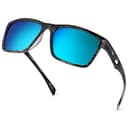
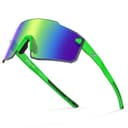
What actually matters in fishing sunglasses
1. Polarization, and nothing else comes close
Light reflecting off a flat water surface is polarized light, and a polarizing filter oriented to block it removes most of that reflection. The practical result is that you stop seeing the sky in the water and start seeing structure, fish and the bottom. There is no substitute for it and no amount of tint achieves the same thing — a darker non-polarized lens just makes everything dimmer, surface glare included. Our polarized vs non-polarized comparison covers the distinction and our test verifies a pair you already own.
2. The tint, which is where the money goes above $100
Once glare is handled, the base tint decides how much contrast you get. A copper, amber or brown base lifts definition against a green or brown background, which is why it is the default in freshwater and inshore fishing. A grey base keeps colours neutral and is the easier all-day choice in very bright conditions. The engineered tints — Costa 580, Oakley Prizm, Maui Jim’s PolarizedPlus2 — are doing something real with specific wavelengths, and nothing under $100 attempts it. Our lens color guide covers which base tint suits which water.
3. Retention, which is the one most anglers learn the hard way
A frame that slides off when you lean over the gunwale is gone. There are three answers: a frame that floats, a retainer cord, or a frame whose temples genuinely grip. Two picks here float, which is the only one of the three that works when you did not see it coming. Our floating sunglasses roundup covers that field and our page on sliding frames covers the cheaper fixes.
4. Coverage, and what salt does to everything
A wrapped frame blocks the light arriving from the side and from under the lens off the water, which on a bright day is a large share of what makes you squint. Salt then tries to destroy whatever you bought — rinse in fresh water before wiping, never wipe salt crystals across a dry lens, which is the fastest way to scratch one. Our cleaning guide covers the order and our base curve guide explains how much wrap you can tolerate before the optics distort.
How to choose between these six
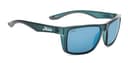
- “Boat or kayak, and I have already lost a pair.” The Cove Float. Polarized, floats, and Hobie states 100% UVA, UVB and UVC blocking and ANSI Z80.3 compliance across its lens range. Our Hobie brand review covers what the brand publishes.
- “Floating, but cheaper.” The Flying Fisherman Lagoon, on a TPX floating frame with 100% UV stated — less than half the Hobie and the same insurance policy.
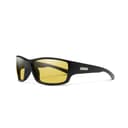
- “I fish at first light, or under cloud.” The Suncloud Hull, a polarized low-light yellow lens. This is the condition a dark lens genuinely ruins, and our low-light roundup covers it across brands — including the finding that not one maker publishes a transmission figure for its low-light tier.
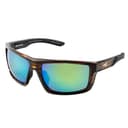
- “I cannot see the knot any more.” The KastKing Waccamaw, a polarized bifocal in a Grilamid wrap, sold in three magnification powers. This is the one thing the premium brands largely do not offer at any price, and if you are over forty it may be the most useful pair on the page. Our bifocal sunglasses roundup covers the format.
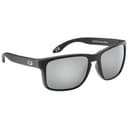
- “One pair for the boat, the truck and the dock.” The FlatRock. A 1.0 mm polarized TAC lens in a Grilamid frame with an oleophobic coating, which is the spec that stops a fingerprint becoming a smear. Our KastKing brand review covers the line and the one place its two flagship models contradict each other.
- “As cheap as I can get away with.” The Etowah. A one-piece rimless frame with a thick 2.0 mm polarized polycarbonate lens — thicker than most, which is the opposite of the usual budget compromise. Cheap enough to own two.
What you are giving up against a $300 pair
Being fair in both directions. Four things, and only one of them is about fishing.
- The engineered tint. Costa’s 580 and Maui Jim’s PolarizedPlus2 manipulate specific wavelengths to raise contrast in water. That is a genuine difference on a long day of sight fishing, and nothing here matches it. Our Costa vs Maui Jim comparison covers the two.
- Glass. Costa’s 580G is the clearest, most scratch-resistant lens sold, and it does not exist under $100 — our glass lens roundup shows exactly where the floor is.
- Service. Premium brands re-lens and repair frames for years. In this band a replacement costs less than a repair. Our repair guide covers the economics.
- Nothing in ultraviolet protection. Every pick here states a UV figure, and the American Academy of Ophthalmology is explicit that price is not a proxy for protection. You are not trading eye safety for money.
For the wider water field, our boating roundup ranks on seeing ACROSS water rather than into it, our lifeguard roundup covers all-day surveillance, and the sport hub indexes every activity we rank.