Which part of Costa are you replacing?
Four things get bought when someone buys a Costa, and they are separable. Work out which one you are actually paying for and the alternative picks itself.
- The glass lens. If this is the requirement, read the next section before you buy anything, because the honest answer is that a cheaper substitute does not exist in this market.
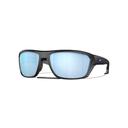
- The contrast tint for looking into water. A polarizing filter kills the surface reflection; a contrast tint changes what you see underneath it. Oakley is the one other house that sells a polarized tint built specifically for that job, and the Split Shot is where it lives.
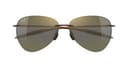
- Polarization you do not have to check. Costa and Maui Jim are both houses where we have never found a non-polarized listing. Maui Jim states the policy outright on its own support site. That is the part that is genuinely easy to replace, and it is why the Sugar Beach is here.
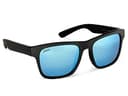
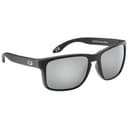
- The fishing frame itself — a big wrapped front, hardware that tolerates salt, a leash point, and in some cases a frame that floats. This is the cheapest part of Costa to replace and the one where the specialist brands genuinely compete: Hobie and Flying Fisherman both publish things Costa does not.
The one substitution that does not exist: glass
We should be blunt about this, because it is the finding most pages in this genre skip. Glass is not a tier you can buy down into. Across our whole registry a glass lens appears at exactly two brands, and the other one sells it in heritage everyday frames rather than fishing wraps. Every other polarized lens we track — from under $10 to the top of the premium band — is polycarbonate, nylon or an unstated plastic.
That matters because glass and polycarbonate are not two grades of the same thing. Glass is harder, which is why it resists the fine scratching that eventually hazes a lens you keep in a center console for five seasons, and it is more optically stable. Polycarbonate is lighter and dramatically more impact-resistant, which is why no sport frame uses glass and why glass has no place in front of a kid, a bat or a paintball. Our glass versus polycarbonate guide works through which one a given buyer actually wants, and our glass lens ranking is the short list of what exists.
So: if you want glass, the alternative to a Costa is a different Costa — usually the 580P version of the same frame if you want the weight off your nose, which is a decision our 580G versus 580P comparison is entirely about. If glass is not the requirement, every pick on this page is in play and most of them cost a fraction of the frame you were looking at.
What each alternative actually gives you
The like-for-like: Oakley Split Shot
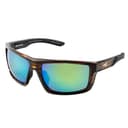
Oakley is the only other premium house with a polarized tint sold specifically for water work, and the Split Shot is the frame built around it: Prizm Deep Water, polarized, Plutonite lens with Oakley’s stated 100% UV, plus a leash and removable side shields in the box. It is sport-specific and it looks it, and it is the most expensive pick here. It is also the only pick that replaces the Costa proposition more or less whole, minus the glass. Our Costa versus Oakley comparison covers the two houses head to head — including the fact that EssilorLuxottica owns both.
The policy substitute: Maui Jim Sugar Beach
If what you liked about Costa was never having to check the SKU, Maui Jim is the substitution, because it states on its own support pages that every pair is polarized and every pair carries 100% UV. The Sugar Beach is the small-fit teardrop in the range, which matters here: Costa’s published sizes are large, so if a Blackfin or a Fantail swamped your face, the answer may not be a cheaper Costa at all. Our Costa versus Maui Jim comparison and our Maui Jim alternatives page cover that brand from both directions.
The specialists: Hobie and Flying Fisherman
These two publish things Costa does not. Hobie states that its lenses block 100% of UVA, UVB and UVC and that they meet or exceed ANSI Z80.3 for refractive power, light transmission and impact resistance — a standard almost nothing in this category cites — and the Coastal Float states a 54 mm lens width, which makes it one of the very few floating frames that fits a narrower face. Flying Fisherman names the material doing the floating: TPX, a polymer less dense than water. Both float, which is the one feature no Costa in our registry offers, and both cost a fraction of one. Our floating roundup ranks that field on its own.
The tint Costa calls Sunrise: Suncloud Hull
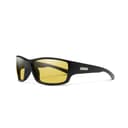
Costa sells a low-light lens and so does Suncloud, at a fraction of the price. The Hull ships in a trim sold explicitly as a polarized Low Light Yellow lens, and Suncloud’s own page for the frame states polarized polycarbonate lenses and 100% UV protection. A yellow lens does not brighten dim light; it removes blue wavelengths, which raises apparent contrast in flat gray conditions. That is a real effect at dawn, under cloud and under tree cover — and it is not a night-driving tool, as our night driving page explains. Our low-light ranking is the full field.
The readers problem: KastKing Waccamaw
Anyone over about forty-five who fishes has the same complaint, and it is not about glare: they cannot tie the knot. The Waccamaw is the best-specified polarized bifocal we could verify, with magnifiers in three powers, a 1.8 mm polarized polycarbonate lens rather than the TAC laminate most sun readers use, a stated oleophobic coating and a full wrap. It is the pick that solves a problem the premium frames mostly ignore. Our bifocal sunglasses ranking covers the category.
The price substitute: KastKing Etowah
A one-piece rimless shield in 2.0 mm polarized polycarbonate, with a published lens thickness, a stated ANSI claim, a water- and oil-repellent coating and a molded hard case in the box — for roughly a tenth of the top pick. It will not match a glass lens for clarity and the one-piece lens cannot be replaced if you scratch it, both of which are on the card. But as the answer to “cheaper alternatives to Costa sunglasses”, it is the most specification per dollar in this registry. Our KastKing brand review is the longer look.
What you give up, honestly
- The glass. Covered above. If you have worn 580G and know what you are missing, no pick here replaces it.
- A published repair route, on most of them. Costa publishes a warranty and a paid repair program; Maui Jim publishes a repair route; Hobie publishes a warranty. Below that, you are usually looking at a replacement rather than a repair, and our repair and replacement-lens guide is honest about which frames are worth fixing.
- The large published fits. Costa states 62 mm and 63 mm fronts. Most of the alternatives here publish no measurement at all, which is a real problem if you have a wide face — our wide-fit ranking and size guide are the workaround.
- The resale and the badge. Worth naming rather than pretending it does not matter. A Costa holds its name on a dock; a KastKing does not.
When you should just buy the Costa
Four cases, and they are real. You want glass, for the reasons above. You fish enough that a paid repair program is cheaper than replacing frames. You need a published large fit and you have been burned guessing from photographs. Or you have worn the 580 contrast tint on water and prefer it to Prizm, which is a preference rather than a specification and is perfectly legitimate — nobody publishes numbers that would settle it either way. Our Costa brand review is the honest version of what the range does and does not do, and our Fantail versus Blackfin comparison is the decision most Costa buyers are actually making.
And if the whole question was price rather than brand, the band pages are a faster route: fishing under $100 shares not one pick with our premium fishing roundup, and under $300 is where the Costa frames themselves sit.