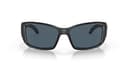
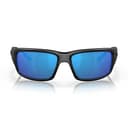
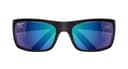
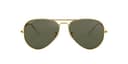
What we ranked on
Four criteria, in this order. At this price the frame is a given, so all four are about the lens and about what the seller is willing to put in writing.
- A stated lens specification, not a lens story. Costa prints the 580G or 580P designation and the millimeter size. Ray-Ban prints “crystal” and “polarized” on the Aviator trim. Maui Jim states PolarizedPlus2 and 100% UV for its entire range on its own support site. Those are checkable. A tint name on its own is not.
- Polarization, or an explicit and good reason not to. Ten of the fifteen frames in this band state the filter. Two of our picks do not, and both have a defensible reason: a runner reading a wet road and a cyclist in dim light are the two buyers for whom the filter is a liability rather than a feature. We say which is which on every card instead of treating non-polarized as a defect.
- Lens material, because this is the band where it becomes a choice. Glass is the most scratch-resistant and the most optically stable, and the heaviest. Polycarbonate is lighter and far more impact-tolerant. Below $200 you mostly do not get to choose; here you do, and the right answer depends on whether your pair lives on a boat or in a gym bag. Our glass versus polycarbonate guide works through it.
- A real repair or warranty route. Premium frames get sat on like any others. Costa publishes a limited warranty plus a paid repair program for out-of-warranty damage; Maui Jim publishes a repair route of its own. That is worth more over five years than any tint, and our repair and replacement-lens guide covers what each route actually includes.
The same frame, twice, at two prices
This is the clearest illustration of the band we have, and it is in our own registry. The Ray-Ban RB3025 Aviator appears here in two trims. One has a non-polarized G-15 lens. The other has a polarized crystal lens. Everything else — the teardrop shape, the metal frame, the 58 mm size, the case and cloth, the Italian manufacture — is the same. One sits below $200 and one sits in this band, and the gap between them is a polarizing filter.
We are not going to print the gap as a number, because both numbers move; the two product rows on this site carry today’s figures and the date they were read. What matters is the structure of the decision: at this rung, the upgrade you are paying for is almost always a lens feature, not a better-made frame. Our page on the two Ray-Ban trims is the long version, and it is the single most useful thing to read before you spend here.
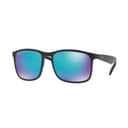
The same logic explains the Chromance pick. Chromance is Ray-Ban’s polarized, contrast-enhancing lens line rather than a frame family, so the badge on the temple tells you nothing about what you are getting — the listing does. Ray-Ban sells non-polarized trims of the very same RB4264 model, which the listing itself acknowledges. Read the SKU.
Why this band is full of water frames
Three of our seven picks are built for the water, and that is not a quirk of our taste. It is what the band contains. The two houses that treat polarization as a standard rather than a trim level both grew out of the ocean — Costa out of fishing, Maui Jim out of Hawaii — and their core frames land between $200 and $300. If you are buying sunglasses for a boat, a flats skiff or a week on a bright coast, this band is the one built for you.
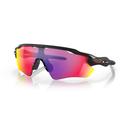
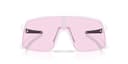
If you are not, the band still works, but you have to choose deliberately: the two Ray-Bans here are everyday frames, the Radar EV is a sport frame, and the Sutro Lite S is a dim-light frame. Our fishing roundup and our boating roundup cover the water use cases on their own terms, including the cheaper frames that do the same job less comfortably.
Where the money stops helping
Three honest limits, because a page that tells you a $300 frame is better at everything is not a page worth reading.
- Ultraviolet protection does not improve. UV400 is a ceiling, not a rung: blocking 100% of ultraviolet up to 400 nm is the top of the scale and it is available for about ten dollars. The American Academy of Ophthalmology makes the same point — price is not a proxy for protection. Paying here buys optics, coverage and durability, not more UV safety. Our page on whether expensive sunglasses are worth it is the long answer.
- The filter itself is not graded. No brand in this band, and none at any price, publishes a polarization efficiency or extinction-ratio figure. A $25 polarized lens and a $296 polarized lens both get the word and neither gets a number. What the expensive one adds is the medium around the filter.
- Fit is still a lottery unless the listing publishes numbers. Costa states its millimeter sizes and Ray-Ban states a lens width. Beyond that, frame weights are almost never published at this price. If you have a wide face or a low nose bridge, our size guide and low-bridge guide will do more for you than another $100.
Should you spend this much at all?
Three reasons to, and they are all structural rather than aspirational. You want glass, which effectively does not exist below this band. You want a brand where polarization is the house standard, so you cannot buy the wrong trim by accident. Or you want a frame that will be repaired rather than replaced, which at this price is a published program rather than a hope.
Three reasons not to. You lose sunglasses — in which case our under-$100 picks are the honest answer and the money saved buys three spares. You mainly want glare control, which is a commodity: polarized under $100 ranks seven frames that state both the filter and a UV figure. Or you want a specific sport lens, where a $90 purpose-built frame routinely beats a $250 general one — our sport hub is organized that way.
And if you are shopping the band above this one, the honest finding is that it gets much thinner very fast: we track exactly one frame above $300, and what it adds over the picks here is a brand name rather than a lens you could identify in a blind comparison.