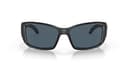
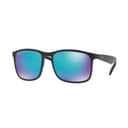
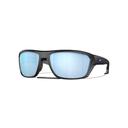
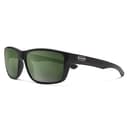
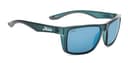
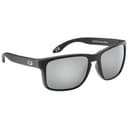
The verdict first. Our top pick is the Costa Blackfin in 580P, the closest like-for-like substitute sold: a polarized lens as standard, 100% UV stated, a published warranty behind it, and a wrapped 62 mm front that blocks more low-angle side light than most Maui Jim frames do. The budget pick is the Flying Fisherman Lagoon, at roughly a tenth of the price, polarized, 100% UV stated, and from the one brand in its category that names the polymer doing the floating.
What Maui Jim is known for, stated fairly and from its own pages. Three things, and the first is the one that actually matters when you go looking for a substitute. There is no exception anywhere in the range. The brand’s own support pages answer both questions without qualification: every pair is polarized — with a film the brand says eliminates 99.9% of glare — and every pair carries PolarizedPlus2 lenses with 100% UV protection. Second, PolarizedPlus2 is a bundle rather than a tint: the brand describes it as glare elimination plus UV and blue-light filtering, color enhancement, scratch resistance, an anti-reflective layer and oil- and water-repellent treatments, in one lens. Third, there is a published repair route — an out-of-warranty service that quotes you for a repair and replaces lenses as a pair — which is a real, checkable thing that most of this market does not offer at all.
Two things it is not, both of them facts rather than complaints. It is not cheap — every Maui Jim frame in our registry sits in the top price bracket on this site, above the Costa and Oakley frames below it. And it is no longer independent: Kering Eyewear completed its acquisition of the brand in October 2022 and holds more than 90% of it, in a portfolio alongside Gucci and Cartier. That is worth knowing if part of what you were buying was the Hawaii-garage-brand story, and it changes nothing about the lens.
Here is the spine of this page. Because Maui Jim has no exceptions, the test an alternative has to pass is a per-SKU one, and it is the test most premium brands fail. In this registry the base Oakley Holbrook, the Frogskins, the original Wayfarer and the G-15 Aviator are all non-polarized, and Ray-Ban’s contrast-enhancing Chromance lens is one line you have to seek out rather than the house standard. So every pick below is a specific listing whose own source states both polarization and a UV figure — not a brand we trust in general. Where a frame is sold in both polarized and non-polarized trims, we say so on the card.
And a note on what “alternative” means here. Every frame below is a different design from a named maker. None of them is a copy of a Maui Jim, and if you find a listing selling something that looks exactly like one at a fraction of the price, that is a counterfeit rather than an alternative — and the specification you cannot verify on a counterfeit is the ultraviolet one. Our guide to spotting fakes covers the tells.
Every price comparison here is made against our live feed, last refreshed on November 19, 2026. The button on each row carries the current number and the date it was read.
Matched to what you were buying
Three of the ten autocomplete suggestions for this query name a specific Maui Jim model, so the useful way to organize this is by what you were actually looking at rather than by brand.
Instead of a Red Sands or a Kawika — the everyday polarized frame
The Suncloud Mayor, and the gap is smaller than the price difference suggests. You lose the color-enhancement layer, the anti-reflective coating and the repair program. You keep a polarized polycarbonate lens and a stated 100% UV figure, and you gain something Maui Jim does not publish anywhere we can find: a base curve. Suncloud states 6 base and a medium fit on the Mayor, which is a real fit specification in a market where fit is otherwise guesswork. Our Suncloud review covers the brand and our base curve guide explains the number.
If the color-enhancing lens is the specific thing you want, the Ray-Ban RB4264 in Chromance is the closest substitute in the market: its own listing describes a polarized lens that maximizes contrast and enhances colors, with 100% UV — the same promise, in Ray-Ban’s premium lens tier. The honest caveat is the one in the spine above: Chromance is a line, not a house standard, and RB4264 is also sold in non-polarized trims, so the SKU matters. Our Maui Jim vs Ray-Ban comparison takes that head-on.
Instead of a Peahi or a Stingray — the wrap for wind and water
The Costa Blackfin in 580P. This is the like-for-like pick and the reason it leads the page: Costa’s 580 lens line is polarized across the board, 100% UV is stated, the brand publishes a warranty, and the Blackfin’s 62 mm wrapped front cuts the low-angle light that gets past a flatter frame when the sun is down near the water. 580P is the polycarbonate version of Costa’s contrast tint rather than the glass one, so it stays light enough for a long day and it scratches more easily than glass — our 580G vs 580P comparison is the decision inside the brand, and Costa vs Maui Jim is the head-to-head.
If you want the sight-fishing lens specifically, the Oakley Split Shot in Prizm Deep Water is the one: polarized, a Plutonite lens that blocks 100% of UV through the material rather than a coating, and it ships with a leash and removable side blinders. It is a large, sport-specific frame and it does not pretend to be an everyday one. Note that most Prizm trims are not polarized — this one is, which is exactly why it is the Oakley on this page. Our Prizm vs polarized page exists because that single fact catches more buyers than anything else in that brand.
Instead of a Baby Beach — the pair you take on the boat
Neither of the float picks is a Maui Jim substitute on optics, and that is not what they are for. If the pair lives on a boat, the specification that decides the purchase is whether it sinks. The Hobie Cove Float is the one to buy if you only own one: Hobie is the only brand in our registry that states 100% UVA, UVB and UVC blocking and cites ANSI Z80.3 for refractive power, light transmission and impact resistance — a standard almost nothing else in this category names. The Flying Fisherman Lagoon does the same job for roughly half of that, and names TPX as the polymer that floats. Both float claims are the manufacturer’s, with no published buoyancy test, and both cards say so. Our floating roundup ranks that category properly.
What you give up, honestly
- The absence of exceptions. With Maui Jim you cannot buy the wrong trim. With every alternative on this page except Costa and the two float brands, the same model number is sold in polarized and non-polarized versions at different prices, and the burden of checking moves to you. That is a real convenience you are trading away, and it is the single most useful thing to understand before you substitute.
- The bundled lens treatments. Anti-reflective coating, oil- and water-repellent layers and a stated blue-light claim come as standard across the Maui Jim range. Among the picks below, only Hobie publishes a comparable repellent treatment. Nobody else here states an anti-reflective layer at all.
- The repair route. Costa, Oakley and Ray-Ban all publish warranties, which is more than most of this market; Maui Jim additionally publishes an out-of-warranty repair service that quotes you for the work. Our repair and replacement guide covers what is realistically fixable and what is not.
- Color enhancement, unless you choose for it. Of the six picks, three carry a contrast- or color-tuned lens — Chromance, Prizm Deep Water and Costa’s 580 tint. The other three are honest neutral or gray polarized lenses, which is the right call for reading water and navigation marks and the wrong one if what you liked about the Maui Jim was the saturation.
What you do not give up
- Ultraviolet protection. This is worth being emphatic about, because it is the only thing sunglasses do for your eye health and it is the thing people assume they are paying for. The AAO states plainly that price is not a proxy for protection. A lens stating UV400 or 100% UVA/UVB protects your eyes identically whether it cost $40 or $340. Our UV400 picks rank that axis on its own terms.
- Polarization. A polarizing filter is a laminated layer, not a premium component, and no brand at any price publishes an efficiency figure you could use to compare one with another — Maui Jim’s own 99.9% glare claim is the closest anyone comes, and it is a brand statement rather than a published test. Our polarized picks under $100 cover what that axis costs at the other end of the market.
- Published fit information, in one case more than Maui Jim gives you. No Maui Jim listing or page we have read publishes a frame weight or a visible light transmission figure. Suncloud publishes a base curve and a fit class. That is a modest win for the cheap pick and it is a real one.
When you should buy the Maui Jim anyway
- You do not want to think about trims. If the idea of checking whether a specific SKU is polarized is the part you were hoping to avoid, the premium is buying exactly that.
- Color saturation is the feature. If what you liked was how the world looks through the lens rather than how dim it gets, the bundled color-enhancement layer is the thing you are paying for, and only Chromance on this page makes the same promise.
- You keep sunglasses for a decade. A published repair route and a lens-replacement service change the arithmetic on a frame you intend to own for years rather than a season.
- You need a small premium fit. The Sugar Beach exists because premium frames usually sit too wide on a narrower face, and nothing on this page is cut that narrow. Our small-face roundup covers the cheaper routes, and our Maui Jim review is the page to read before you spend.