Why metal is the fit answer
Adjustable nose pads
The single most useful feature on this page, and almost exclusive to metal construction. Pads on bendable arms let you raise a frame that sits on your cheeks, lower one that touches your eyelashes, and narrow the bridge on a frame that slides. If frames have never sat right on you — and particularly if your bridge is low or narrow — this is the lever that fixes it. Our low nose bridge guide covers the problem and our adjustment guide covers how far you can safely bend things yourself.
Temple arms that take a set
A metal temple can be curved behind the ear and will hold that curve. That is how you stop a frame bouncing when you walk or riding up when you look down, and it is why metal frames are the standard choice for anyone wearing sunglasses under a hat or a helmet. A plastic temple either springs back or has to be heated.
A thinner frame line
Metal is strong enough to be thin, which is the actual reason a wire frame reads as quieter than an acetate one of the same shape. Practically, that also means less of your peripheral vision is blocked by frame — worth knowing if you have found thick frames distracting while driving.
The three real costs
- Solder joints and hinges are the failure point. A metal frame does not snap across the bridge the way plastic does — it fails at a joint, usually where the pad arm or the hinge is soldered. The good news is that a joint failure is often repairable by an optician, where a snapped acetate front generally is not. Our repair guide covers what is worth fixing at which price.
- It bends and stays bent. The flip side of adjustability. Sit on a TR-90 sport frame and it usually survives; sit on a wire frame and you have a new shape. If your sunglasses live in a bag or a back pocket, that is a real argument for a nylon-family frame instead — our under-$25 roundup has several.
- Heat, cold and salt. Metal conducts, so a metal frame left on a dashboard gets genuinely unpleasant and one worn in freezing wind is cold on the bridge. Cheaper plated metal also corrodes in salt air and sweat, which shows first at the pad arms. Titanium and quality stainless do not; plated base metal does. If the frame is going on a boat, see our boating roundup instead.
How to choose between these six
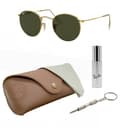
- “I want one metal frame that looks intentional.” The RB3447 Round Metal. The shape that is only really possible in wire, with adjustable pads and 100% UV. Our round frames roundup covers the field and our Ray-Ban brand review covers what the price includes.
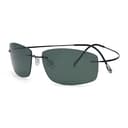
- “I want the lightest, most corrosion-proof option.” The Eyekepper titanium rimless. Titanium does not corrode and weighs very little, and a rimless build removes the frame line entirely. Our rimless roundup covers the trade-offs of rimless construction, which are real.
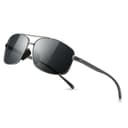
- “Standard frames are too narrow for me.” The SUNGAIT SGT458, at a 62 mm polarized lens on an ultra-light metal front. That is a genuinely wide frame at a price where wide frames usually do not exist. Our wide-face roundup covers the rest.
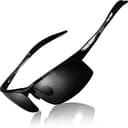
- “Mostly for the car.” The Duco polarized driving frame. A light metal front with a polarized TAC lens, which is the combination that cuts windshield and road glare without adding weight on a long drive. Our driving roundup ranks that field properly — and note that polarization interacts with some dashboard screens, which our page on screens covers.
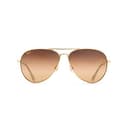
- “I want the best lens in a metal frame.” The Maui Jim Mavericks. A metal teardrop in a large fit with PolarizedPlus2 and an HCL Bronze tint — the most expensive pick here and the one with the strongest lens argument. Our Maui Jim review covers what the brand publishes and what it does not.
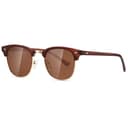
- “I want to spend as little as possible.” The AEVOGUE AE0369. A metal semi-rimless browline, polarized, UV400, and notable because it is the only frame in our browline group whose listing states a lens material at all. Our browline roundup has the context.
Metal, acetate or TR-90?
A short decision, and the one that should come before the shape.
- Metal if fit is your problem, if you wear sunglasses under a hat, if you want a thin frame line, or if you want something an optician can adjust and repair.
- Acetate if you want weight and presence, the deepest colours, and a frame that can be heat-adjusted by a professional. It is also the material behind most heritage shapes — our Wayfarer roundup is almost entirely acetate.
- TR-90 and the nylon family if the frame will be sat on, dropped, sweated in or taken running. It flexes a long way and returns to shape, which metal does not. Our sport hub is built on it.
For the whole range, the everyday hub collects the style roundups and the fit guide covers the measurements. If you came here because nothing fits, start with the size guide — the three numbers on the temple arm will narrow the field faster than any material choice.