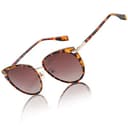
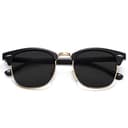
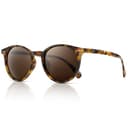
What we ranked on
A retro page can very easily become a mood board, so here is what actually decided the order.
- Does the proportion hold up? Period shapes fail when they are scaled wrong — a round frame that is slightly oval, a cat-eye whose lift is too shallow, a browline whose brow is too thin. The frames here hold their proportion, and where a listing publishes a lens width we quote it on the card.
- A stated ultraviolet figure. Non-negotiable and the single biggest risk in this category, because “vintage style” attracts fashion-first listings. Darkness without a UV filter is worse than no sunglasses, because the dark lens opens your pupil. The American Academy of Ophthalmology is also explicit that price is not a proxy for protection, which cuts both ways on this page.
- What the frame is actually made of. Metal, acetate and moulded plastic age completely differently. Metal bends back; acetate can be heat-adjusted by an optician; cheap moulded frames do neither, and when the hinge goes the frame is finished.
- Whether it works as sunglasses, not just as an object. Three of the seven picks state a polarizing filter. Small round lenses in particular let a lot of light in around the edges, which is a real trade-off rather than a flaw — we flag it where it applies.
The decade-by-decade shortlist
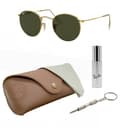
If you want the 1960s look — small, circular, thin metal rim — the Ray-Ban Round Metal is the reference and the SUNGAIT is the inexpensive route to the same proportion. Both suit square, rectangular and angular faces, because a circle is the strongest available counterweight to a straight jaw. Our round sunglasses ranking goes deeper on the shape itself.
If you want the 1950s look — weight along the brow, nothing below — you are choosing between a browline and a cat-eye, and they do opposite things. A browline adds horizontal width and reads as studious; a cat-eye lifts at the outer corner and reads as sharp. Our browline ranking and cat-eye ranking each carry a full field.
If you want the 1980s look — thick frames, straight lines, a trapezoidal lens — that is the Wayfarer family and its descendants, and it has its own page here because it is the most-searched retro shape on the site. Start at our Wayfarer ranking rather than on this page; it covers the original, the modern reissues and the cheaper builds side by side.
If you want the 1930s look — the metal teardrop — our aviator ranking covers it properly, including the fact that the original military brief was glare reduction at altitude rather than style.
Retro frames and face shape, which is the whole game
Period shapes are more sensitive to face shape than modern wraps are, because they were cut before anyone was designing for a mass fit. The rule that holds across every decade on this page: pick the shape that contrasts with your face, not the one that matches it. Round faces look best in angular 1980s frames; square and rectangular faces look best in 1960s circles; long faces want depth rather than width, which the 1950s browline supplies. Heart-shaped faces are the one case that genuinely suits both the aviator and the cat-eye.
Our face-shape guide works through all of this with the geometry rather than with adjectives, and there are dedicated rankings for round faces, square faces, oval faces, heart-shaped faces and long faces.
How much a retro frame is worth paying for
This category has the widest honesty gap on the site, because the thing being sold is a silhouette and a silhouette costs nothing to copy. Three things do genuinely cost money:
- Metal that can be adjusted and re-adjusted. A thin metal rim is the hardest retro frame to make well and the easiest to bend back into shape when it goes wrong. That is most of what separates the $201 frame here from the $17 one.
- A polarizing filter, if you want one. Interestingly it is not the premium frames that carry it here: three of the four cheapest picks on this page state the filter and the most expensive pick does not. That inversion is the subject of our polarized ranking, and it is consistent across the registry rather than a quirk of this page.
- A published warranty or repair route. Retro frames tend to be kept longer than sport frames, so this matters more here than almost anywhere else.
What it does not buy is ultraviolet protection. UV400 is a ceiling and it is available at around ten dollars — our UV400 ranking counts how many listings in this registry actually state the figure, and the answer surprises most people. If the look is the only thing you are buying, buy the look cheaply and keep the lens honest.